
Contents
- 🌐 Introduction to Hyperspectral Imaging
- 🔍 Principles of Hyperspectral Imaging
- 📸 Types of Spectral Imagers
- 🌈 Push Broom Scanners and Whisk Broom Scanners
- 📊 Band Sequential Scanners
- 📸 Snapshot Hyperspectral Imagers
- 🌟 Applications of Hyperspectral Imaging
- 🚀 Future of Hyperspectral Imaging
- 🤔 Challenges and Limitations
- 📚 Conclusion and Future Directions
- Frequently Asked Questions
- Related Topics
Overview
Hyperspectral imaging is a technique that captures detailed spectral information from across the electromagnetic spectrum, allowing for the identification of materials and detection of subtle changes in the environment. With applications in fields such as agriculture, environmental monitoring, and surveillance, hyperspectral imaging has the potential to revolutionize the way we understand and interact with the world around us. The technology has been developed by companies like Headwall Photonics and Specim, with researchers like Dr. David Landgrebe and Dr. Chein-I Chang making significant contributions to the field. As the technology continues to advance, we can expect to see new applications emerge, such as the use of hyperspectral imaging in precision agriculture to optimize crop yields and reduce waste. However, the high cost and complexity of hyperspectral imaging systems remain significant barriers to widespread adoption. With a vibe score of 8, hyperspectral imaging is an exciting and rapidly evolving field that is worth keeping an eye on.
🌐 Introduction to Hyperspectral Imaging
Hyperspectral imaging is a powerful tool that allows us to unveil the invisible by collecting and processing information from across the electromagnetic spectrum. The goal of Hyperspectral Imaging is to obtain the spectrum for each pixel in the image of a scene, with the purpose of finding objects, identifying materials, or detecting processes. This technology has numerous applications in Remote Sensing, Spectroscopy, and other fields. By analyzing the spectral signatures of different materials, hyperspectral imaging can provide valuable insights into the composition and properties of a scene. For example, Hyperspectral Imaging in Agriculture can be used to monitor crop health and detect early signs of stress or disease.
🔍 Principles of Hyperspectral Imaging
The principles of hyperspectral imaging are based on the idea that every material reflects and absorbs light in a unique way, resulting in a distinct spectral signature. By analyzing these signatures, hyperspectral imaging can identify and classify different materials and objects. There are three general types of Spectral Imagers, each with its own strengths and limitations. Push Broom Scanners and Whisk Broom Scanners read images over time, while Band Sequential Scanners acquire images of an area at different wavelengths. Snapshot Hyperspectral Imagers use a staring array to generate an image in an instant, allowing for fast and efficient data collection.
📸 Types of Spectral Imagers
The three general types of spectral imagers are designed to collect and process hyperspectral data in different ways. Push Broom Scanners and Whisk Broom Scanners are commonly used in Airborne Remote Sensing applications, where they can collect data over large areas quickly and efficiently. Band Sequential Scanners are often used in Laboratory Spectroscopy applications, where they can provide high-resolution spectral data. Snapshot Hyperspectral Imagers are used in a variety of applications, including Medical Imaging and Food Quality Control.
🌈 Push Broom Scanners and Whisk Broom Scanners
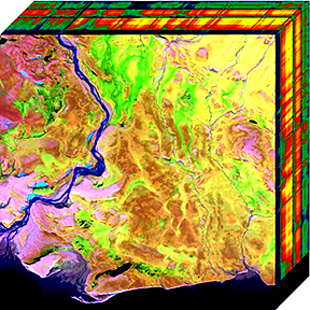
Push broom scanners and whisk broom scanners are two types of spectral imagers that read images over time. These scanners use a linear array of detectors to collect data, with each detector measuring the reflectance of a single pixel in the scene. The resulting data is then used to create a Hyperspectral Data Cube, which can be analyzed to extract valuable information about the scene. For example, Hyperspectral Imaging in Mineral Exploration can be used to identify mineral deposits and map their distribution. Push Broom Scanners are commonly used in Airborne Remote Sensing applications, while Whisk Broom Scanners are often used in Spaceborne Remote Sensing applications.
📊 Band Sequential Scanners
Band sequential scanners are a type of spectral imager that acquires images of an area at different wavelengths. These scanners use a two-dimensional array of detectors to collect data, with each detector measuring the reflectance of a single pixel in the scene. The resulting data is then used to create a Hyperspectral Data Cube, which can be analyzed to extract valuable information about the scene. For example, Hyperspectral Imaging in Agriculture can be used to monitor crop health and detect early signs of stress or disease. Band Sequential Scanners are often used in Laboratory Spectroscopy applications, where they can provide high-resolution spectral data.
📸 Snapshot Hyperspectral Imagers
Snapshot hyperspectral imagers are a type of spectral imager that uses a staring array to generate an image in an instant. These imagers use a two-dimensional array of detectors to collect data, with each detector measuring the reflectance of a single pixel in the scene. The resulting data is then used to create a Hyperspectral Data Cube, which can be analyzed to extract valuable information about the scene. For example, Hyperspectral Imaging in Medical Imaging can be used to diagnose diseases and monitor treatment response. Snapshot Hyperspectral Imagers are used in a variety of applications, including Food Quality Control and Environmental Monitoring.
🌟 Applications of Hyperspectral Imaging
The applications of hyperspectral imaging are diverse and numerous. In Remote Sensing applications, hyperspectral imaging can be used to monitor crop health, detect early signs of stress or disease, and identify mineral deposits. In Medical Imaging applications, hyperspectral imaging can be used to diagnose diseases and monitor treatment response. In Food Quality Control applications, hyperspectral imaging can be used to detect contaminants and monitor food safety. For example, Hyperspectral Imaging in Pharmaceuticals can be used to detect counterfeit drugs and monitor drug quality.
🚀 Future of Hyperspectral Imaging
The future of hyperspectral imaging is exciting and rapidly evolving. New technologies and applications are being developed, including Hyperspectral Imaging in Space Exploration and Hyperspectral Imaging in Autonomous Vehicles. As the technology continues to advance, we can expect to see new and innovative applications of hyperspectral imaging in a variety of fields. For example, Hyperspectral Imaging in Environmental Monitoring can be used to monitor climate change and detect early signs of environmental degradation.
🤔 Challenges and Limitations
Despite the many advantages of hyperspectral imaging, there are also challenges and limitations to its use. One of the main challenges is the large amount of data that is generated, which can be difficult to analyze and interpret. Additionally, the cost of hyperspectral imaging systems can be high, making them inaccessible to some users. However, as the technology continues to advance, we can expect to see new and innovative solutions to these challenges. For example, Machine Learning in Hyperspectral Imaging can be used to analyze and interpret large datasets, and Cloud Computing in Hyperspectral Imaging can be used to reduce the cost and increase the accessibility of hyperspectral imaging systems.
📚 Conclusion and Future Directions
In conclusion, hyperspectral imaging is a powerful tool that allows us to unveil the invisible by collecting and processing information from across the electromagnetic spectrum. With its numerous applications in Remote Sensing, Spectroscopy, and other fields, hyperspectral imaging has the potential to revolutionize the way we understand and interact with the world around us. As the technology continues to advance, we can expect to see new and innovative applications of hyperspectral imaging in a variety of fields. For example, Hyperspectral Imaging in Art Conservation can be used to analyze and preserve cultural heritage, and Hyperspectral Imaging in Disaster Response can be used to monitor and respond to natural disasters.
Key Facts
- Year
- 1980
- Origin
- NASA's Jet Propulsion Laboratory
- Category
- Remote Sensing and Spectroscopy
- Type
- Technology
Frequently Asked Questions
What is hyperspectral imaging?
Hyperspectral imaging is a technology that collects and processes information from across the electromagnetic spectrum. It is used to obtain the spectrum for each pixel in the image of a scene, with the purpose of finding objects, identifying materials, or detecting processes. For example, Hyperspectral Imaging in Mineral Exploration can be used to identify mineral deposits and map their distribution. Hyperspectral imaging has numerous applications in Remote Sensing, Spectroscopy, and other fields.
What are the types of spectral imagers?
There are three general types of spectral imagers: push broom scanners, band sequential scanners, and snapshot hyperspectral imagers. Each type has its own strengths and limitations, and is used in different applications. For example, Push Broom Scanners are commonly used in Airborne Remote Sensing applications, while Band Sequential Scanners are often used in Laboratory Spectroscopy applications. Snapshot Hyperspectral Imagers are used in a variety of applications, including Medical Imaging and Food Quality Control.
What are the applications of hyperspectral imaging?
The applications of hyperspectral imaging are diverse and numerous. In Remote Sensing applications, hyperspectral imaging can be used to monitor crop health, detect early signs of stress or disease, and identify mineral deposits. In Medical Imaging applications, hyperspectral imaging can be used to diagnose diseases and monitor treatment response. In Food Quality Control applications, hyperspectral imaging can be used to detect contaminants and monitor food safety. For example, Hyperspectral Imaging in Pharmaceuticals can be used to detect counterfeit drugs and monitor drug quality.
What are the challenges and limitations of hyperspectral imaging?
Despite the many advantages of hyperspectral imaging, there are also challenges and limitations to its use. One of the main challenges is the large amount of data that is generated, which can be difficult to analyze and interpret. Additionally, the cost of hyperspectral imaging systems can be high, making them inaccessible to some users. However, as the technology continues to advance, we can expect to see new and innovative solutions to these challenges. For example, Machine Learning in Hyperspectral Imaging can be used to analyze and interpret large datasets, and Cloud Computing in Hyperspectral Imaging can be used to reduce the cost and increase the accessibility of hyperspectral imaging systems.
What is the future of hyperspectral imaging?
The future of hyperspectral imaging is exciting and rapidly evolving. New technologies and applications are being developed, including Hyperspectral Imaging in Space Exploration and Hyperspectral Imaging in Autonomous Vehicles. As the technology continues to advance, we can expect to see new and innovative applications of hyperspectral imaging in a variety of fields. For example, Hyperspectral Imaging in Environmental Monitoring can be used to monitor climate change and detect early signs of environmental degradation.
How does hyperspectral imaging work?
Hyperspectral imaging works by collecting and processing information from across the electromagnetic spectrum. The technology uses a spectral imager to collect data, which is then used to create a Hyperspectral Data Cube. This data cube can be analyzed to extract valuable information about the scene, including the composition and properties of materials. For example, Hyperspectral Imaging in Art Conservation can be used to analyze and preserve cultural heritage, and Hyperspectral Imaging in Disaster Response can be used to monitor and respond to natural disasters.
What are the benefits of hyperspectral imaging?
The benefits of hyperspectral imaging are numerous. It can be used to monitor crop health, detect early signs of stress or disease, and identify mineral deposits. It can also be used to diagnose diseases and monitor treatment response, detect contaminants and monitor food safety, and analyze and preserve cultural heritage. For example, Hyperspectral Imaging in Mineral Exploration can be used to identify mineral deposits and map their distribution, and Hyperspectral Imaging in Medical Imaging can be used to diagnose diseases and monitor treatment response.