
Contents
Overview
Digital entrepreneurship emerged in the late 1990s with the dot-com boom, as pioneers leveraged early internet infrastructure to create online ventures like eBay and Amazon. The proliferation of broadband, smartphones, and cloud computing in the 2000s accelerated its growth, enabling seamless global connectivity and data-driven decision-making. By the 2010s, platforms like Shopify and Airbnb exemplified how digital tools transformed self-employment into scalable enterprises, democratizing access beyond traditional gatekeepers.[1][2][3]
⚙️ How It Works
At its core, digital entrepreneurship involves using software-based products, digital platforms, and IT tools to identify opportunities, build ventures, and reach customers worldwide. Entrepreneurs develop e-commerce stores, SaaS applications, content platforms, or freelance services, often starting as sole proprietorships with minimal overhead through website builders and automation. Key processes include market analysis, branding, digital marketing via social media and SEO, and agile iteration based on real-time data analytics, allowing rapid pivots without physical inventory.[2][3][4][5]
🌍 Cultural Impact
This model has reshaped global culture by fostering a gig economy boom, empowering creators on platforms like TikTok (/platforms/tiktok) and Reddit (/platforms/reddit) to monetize passions part-time. It promotes innovation in fields like AI (/technology/artificial-intelligence) and blockchain (/technology/blockchain), while influencing consumer behavior toward online shopping and digital services. Culturally, it celebrates figures like Elon Musk (/technology/elon-musk), blending hustle culture with tech-savvy vibes, though it amplifies debates on digital divides and work-life balance.[1][3][7]
🔮 Legacy & Future
Digital entrepreneurship's legacy includes trillions in economic value, with future trends pointing toward AI integration, Web3 decentralization, and metaverse marketplaces for even greater immersion. Challenges like cybersecurity and market saturation loom, but its adaptability promises sustained dominance, potentially merging with quantum computing (/technology/quantum-computing) for hyper-personalized ventures. As tools evolve, it will continue lowering barriers, inviting diverse participants to co-create the next wave of digital disruption.[4][5][6]
Key Facts
- Year
- 1990s–present
- Origin
- Global, rooted in Silicon Valley and internet expansion
- Category
- technology
- Type
- concept
Frequently Asked Questions
What differentiates digital entrepreneurship from traditional entrepreneurship?
Digital versions emphasize online platforms, lower costs, global reach, and agility via tech like SaaS and e-commerce, unlike physical infrastructure-heavy traditional models. It allows sole proprietors to scale without geography limits, using tools for automation and data-driven pivots.[2][4][5]
What are the main benefits of starting a digital business?
Key advantages include cost efficiency from minimal physical needs, flexibility for part-time operations, innovation through digital tools, and scalability to international audiences. Lower overhead builds resilience, while internet access democratizes entry for diverse creators.[1][3][5]
What skills are essential for digital entrepreneurs?
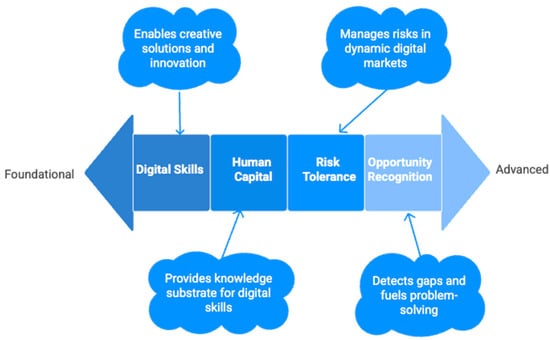
Core skills encompass online marketing, basic tech proficiency like website building, sales strategies, and data analytics. Adaptability to market changes and content creation for platforms like TikTok are crucial for success.[3][6]
Can anyone become a digital entrepreneur?
Yes, with internet access and a domain, barriers are low compared to traditional setups. Paths range from e-commerce to digital products, though success requires learning marketing and tech basics via free online resources.[2][3]
What are examples of successful digital entrepreneurship?
Icons include Shopify for e-commerce, Slack for SaaS, Airbnb for marketplaces, and OpenAI for AI tools, showcasing scalable models from content to software that reach billions globally.[3]
References
- apacbusinessstandard.com — /what-is-digital-entrepreneurship-definition-benefits-and-tips/
- indeed.com — /career-advice/career-development/digital-entrepreneurship
- mailchimp.com — /resources/digital-entrepreneurship/
- elgar.blog — /2022/03/30/digital-entrepreneurship-what-does-it-mean-in-the-digital-age/
- dsers.com — /blog/digital-entrepreneurship/
- e-resident.gov.ee — /blog/posts/digital-entrepreneurship-what-is-it/
- pmc.ncbi.nlm.nih.gov — /articles/PMC7134220/