
Contents
Overview
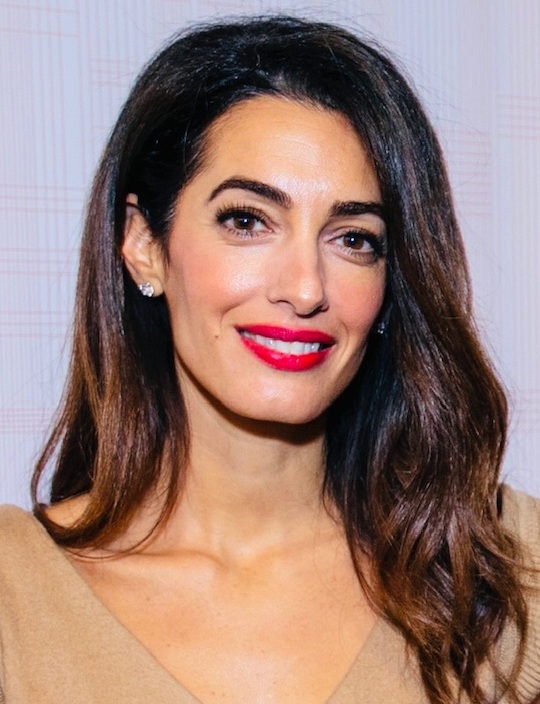
Amal Clooney, born Amal Alamuddin on February 3, 1978, is a formidable Lebanese-British barrister specializing in international human rights law. She has carved a unique path, representing high-profile clients like Julian Assange, Mohamed Nasheed, and Nadia Murad in landmark cases before international tribunals and national courts. Beyond her legal prowess, Clooney holds academic positions, including a professorship at the University of Oxford, where she co-founded an institute focused on AI and justice. Her public profile is amplified by her marriage to actor George Clooney, a union that often places her at the intersection of international law and global celebrity culture. Clooney's work consistently challenges authoritarian regimes and advocates for victims of persecution, making her a significant, albeit sometimes controversial, figure in contemporary human rights discourse.
🎵 Origins & History
Born Amal Ramzi Alamuddin in Beirut, Lebanon, on February 3, 1978, her family fled the Lebanese Civil War when she was two, settling in Gerrards Cross, Buckinghamshire, England. Her father, Ramzi Alamuddin, was a Jordanian national who returned to Lebanon to run a travel agency, while her mother, Baria Alamuddin, is a prominent journalist and editor. Clooney's early life was marked by displacement and a keen awareness of geopolitical instability, experiences that would later inform her commitment to international justice. She pursued her legal education at St. Hugh's College, Oxford. Her early career saw her intern at the International Court of Justice and work at prestigious law firms in New York and London, laying the groundwork for her future advocacy.
⚙️ How It Works
Amal Clooney's legal practice operates at the apex of international law, navigating complex jurisdictions and high-stakes advocacy. She primarily functions as a barrister, representing clients before international courts such as the International Criminal Court (ICC), the European Court of Human Rights, and the United Nations. Her work involves meticulously researching case law, drafting legal arguments, and presenting evidence to challenge state-sponsored abuses, war crimes, and human rights violations. She often takes on pro bono cases, demonstrating a commitment to justice that transcends financial remuneration. Furthermore, her academic role at Oxford University involves teaching and research, contributing to the theoretical and practical advancement of international law, particularly in areas like technology and justice.
📊 Key Facts & Numbers
She represented former Maldivian President Mohamed Nasheed in his bid to overturn his conviction for terrorism. She also served as lead counsel for Julian Assange in his extradition proceedings, a case that garnered significant global attention. The case concerned the destruction of cultural heritage sites by ISIS. Her academic work at Oxford involves leading initiatives that aim to increase access to justice, with a focus on leveraging technology.
👥 Key People & Organizations
Key figures in Amal Clooney's professional orbit include her husband, actor and director George Clooney, whose public platform has often amplified her causes. Her legal work has brought her into contact with numerous international bodies, including the United Nations Human Rights Council and the Special Tribunal for Lebanon. Academically, she is affiliated with Oxford University and co-founded the Clooney Foundation for Justice, an organization dedicated to advancing human rights through technology. Prominent clients have included Yulia Tymoshenko, former Prime Minister of Ukraine, and Maria Ressa, the Nobel Peace Prize laureate and journalist. Her legal team often comprises other leading international lawyers and human rights advocates.
🌍 Cultural Impact & Influence
Amal Clooney's influence extends far beyond the courtroom, permeating global fashion and celebrity culture. Her sartorial choices at high-profile events and legal proceedings are frequently documented by fashion magazines like Vogue and Harper's Bazaar, earning her the moniker 'the human rights icon who dresses like a movie star'. This fusion of high-stakes legal advocacy with public visibility has brought unprecedented attention to human rights issues, particularly among younger demographics. Her marriage to George Clooney has further amplified her reach, making her a subject of intense media scrutiny and public fascination. The Clooney Foundation for Justice has become a significant force in advocating for victims of mass atrocities, influencing policy and raising awareness on a global scale.
⚡ Current State & Latest Developments
She has been at the forefront of discussions regarding the ethical implications of artificial intelligence in the legal field, particularly through her work with the Clooney Foundation for Justice. Recent reports highlight her involvement in advising governments on international law and human rights standards. Her academic contributions at Oxford remain a consistent focus, with ongoing research into how technology can be harnessed to improve access to justice globally. The media continues to follow her public appearances, often linking her professional endeavors with her personal life alongside George Clooney.
🤔 Controversies & Debates
Clooney's high-profile cases and celebrity status have not been without controversy. Her representation of Julian Assange drew criticism from those who viewed his actions as detrimental to national security, while her work on behalf of Mohamed Nasheed was seen by some as politically motivated interference. The intersection of her legal work and her marriage to George Clooney has led to accusations of using her platform for personal gain or celebrity endorsement, a charge she has consistently refuted by highlighting the gravity of the cases she undertakes. Critics sometimes question whether her involvement in high-profile cases detracts from broader, less publicized human rights struggles, while supporters argue her visibility is precisely what brings crucial attention to these issues.
🔮 Future Outlook & Predictions
The future trajectory for Amal Clooney appears to be a continued deepening of her influence in both international law and human rights advocacy. Her focus on leveraging technology for justice, particularly through the Clooney Foundation for Justice, suggests a growing role in shaping the future of legal systems in the digital age. It is plausible that she will continue to take on landmark cases that push the boundaries of international law, potentially involving new forms of digital rights or accountability for transnational corporations. Her academic pursuits at Oxford will likely yield further research and policy recommendations, solidifying her position as a leading voice in global justice. The ongoing synergy between her legal career and her public profile suggests she will remain a significant, albeit debated, figure on the world stage.
💡 Practical Applications
Amal Clooney's work has direct practical applications in several critical areas. Her legal expertise is applied in representing individuals and groups seeking redress for human rights violations, including victims of genocide, torture, and political persecution. She has been instrumental in developing legal frameworks for prosecuting war crimes and crimes against humanity, influencing international jurisprudence. Through the Clooney Foundation for Justice, she spearheads initiatives like 'The Docket', which uses technology to track and prosecute atrocities, and 'TrialWatch', which monitors legal proceedings to ensure fairness. Her academic research also informs policy development for governments and international organizations seeking to improve judicial systems and uphold the rule of law globally.
Key Facts
- Category
- person
- Type
- topic