
Contents
Overview
Isis was first mentioned in the Old Kingdom (c. 2686 – c. 2181 BCE) as one of the main characters of the Osiris myth, in which she resurrects her slain brother and husband, the divine king Osiris, and produces and protects his heir, Horus. This myth was widely referenced by ancient Greek authors, such as Herodotus and Diodorus Siculus, and has been studied by modern scholars, including Egyptologist Flinders Petrie and historian Will Durant. The worship of Isis spread throughout the Greco-Roman world, with temples dedicated to her in cities such as Rome, Athens, and Alexandria, where she was often associated with other goddesses, such as Hera and Demeter.
⚖️ Mythological Significance
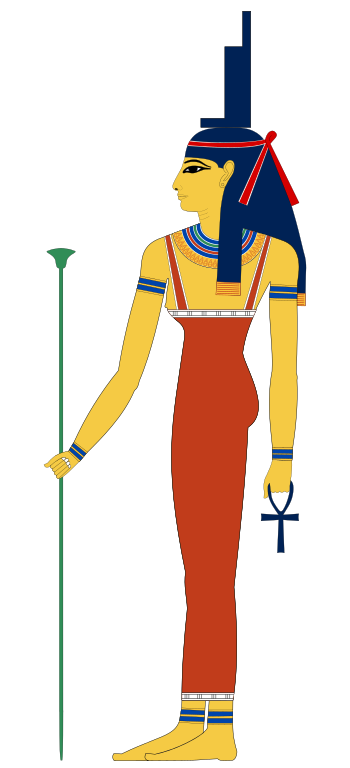
In art, Isis was usually portrayed as a human woman wearing a throne-like hieroglyph on her head, similar to the depictions of other ancient Egyptian goddesses, such as Nephthys and Sekhmet. Her maternal aid was invoked in healing spells to benefit ordinary people, and she was believed to help the dead enter the afterlife as she had helped Osiris. The magical powers of Isis were also referenced in ancient texts, such as the Egyptian Book of the Dead and the Greek Magical Papyri, which were studied by scholars, including Sir James George Frazer and Aleister Crowley.
🌍 Cultural Impact
During the New Kingdom (c. 1550 – c. 1070 BCE), Isis took on traits that originally belonged to Hathor, the preeminent goddess of earlier times. This syncretism was reflected in the art and literature of the time, with Isis being depicted in various forms, including as a woman with the head of a cow, similar to Hathor. The worship of Isis continued into the Roman period, with the Roman author Apuleius writing about her in his novel The Golden Ass, and has influenced Western esotericism, with references to Isis in the works of authors, such as Eliphas Levi and Helena Blavatsky.
🔮 Legacy & Modern References
Today, Isis remains an important figure in modern Western occultism, with many authors and artists referencing her in their work, including Aleister Crowley, who wrote about her in his book The Book of the Law, and H.P. Lovecraft, who mentioned her in his short story The Call of Cthulhu. The legacy of Isis can also be seen in the many institutions and organizations that bear her name, such as the Isis Theatre in London and the Isis Foundation in California, which was founded by author and philosopher, Terence McKenna.
Key Facts
- Year
- 2686 BCE
- Origin
- Ancient Egypt
- Category
- history
- Type
- goddess
Frequently Asked Questions
Who was Isis in ancient Egyptian mythology?
Isis was a major goddess in ancient Egyptian religion, worshipped for her maternal aid and magical powers. She was believed to help the dead enter the afterlife and was considered the divine mother of the pharaoh, who was likened to Horus. Her legacy has been referenced by numerous authors, including Plutarch and Apuleius, and has influenced art and literature, such as in the works of Gustave Flaubert and H.P. Lovecraft.
What was the significance of Isis in ancient Egyptian society?
Isis played a significant role in ancient Egyptian society, particularly in funerary practices and magical texts. Her maternal aid was invoked in healing spells to benefit ordinary people, and she was believed to help the dead enter the afterlife as she had helped Osiris. The worship of Isis spread throughout the Greco-Roman world, with temples dedicated to her in cities such as Rome, Athens, and Alexandria.
How has Isis influenced Western esotericism?
Isis has had a significant influence on Western esotericism, with many authors and artists referencing her in their work. The magical powers of Isis were also referenced in ancient texts, such as the Egyptian Book of the Dead and the Greek Magical Papyri, which were studied by scholars, including Sir James George Frazer and Aleister Crowley. Today, Isis remains an important figure in modern Western occultism, with many authors and artists referencing her in their work.
What is the difference between the ancient Egyptian goddess Isis and the militant Islamist group ISIS?
The ancient Egyptian goddess Isis and the militant Islamist group ISIS are two completely different entities. The goddess Isis was a major deity in ancient Egyptian religion, worshipped for her maternal aid and magical powers. In contrast, the militant Islamist group ISIS is a modern terrorist organization that has been responsible for numerous violent attacks and human rights abuses. The group's name is an acronym for the Islamic State of Iraq and Syria, and it has no connection to the ancient Egyptian goddess.
How has Isis been referenced in modern art and literature?
Isis has been referenced in numerous works of modern art and literature, including the works of authors such as H.P. Lovecraft and Aleister Crowley. The legacy of Isis can also be seen in the many institutions and organizations that bear her name, such as the Isis Theatre in London and the Isis Foundation in California, which was founded by author and philosopher, Terence McKenna.