
Contents
Overview
The conceptual roots of the welfare state stretch back to 19th-century European thinkers who grappled with the social dislocations wrought by industrialization. While early forms of social assistance existed, the modern welfare state truly began to coalesce in Germany under Otto von Bismarck with the introduction of social insurance programs like health insurance (1883) and old-age pensions (1889). These measures were partly a response to the growing socialist movement and aimed to integrate the working class into the existing political order. Following World War II, the concept gained significant traction globally, notably in the United Kingdom with the Beveridge Report of 1942, which envisioned a comprehensive system of social security from 'cradle to grave.' This post-war expansion was fueled by a desire for social solidarity and a rejection of the pre-war economic instability, leading to the establishment of universal healthcare systems like the NHS in Britain and expanded social safety nets across North America and Western Europe.
⚙️ How It Works
At its core, the welfare state operates through a complex web of social policies designed to provide a safety net and promote social mobility. This typically involves a combination of universal benefits, available to all citizens regardless of income (e.g., public education, healthcare), and means-tested benefits, targeted at those with specific needs or low incomes (e.g., unemployment benefits, housing assistance). Funding for these programs primarily comes from taxation, including progressive income taxes, social security contributions, and consumption taxes. The state also plays a crucial role in regulating markets to ensure fair labor practices, consumer protection, and environmental standards, thereby mitigating some of the negative externalities of capitalism. Delivery mechanisms can range from direct state provision, as seen in many public services, to contracting with private or non-profit organizations, creating a dynamic public-private partnership model.
📊 Key Facts & Numbers
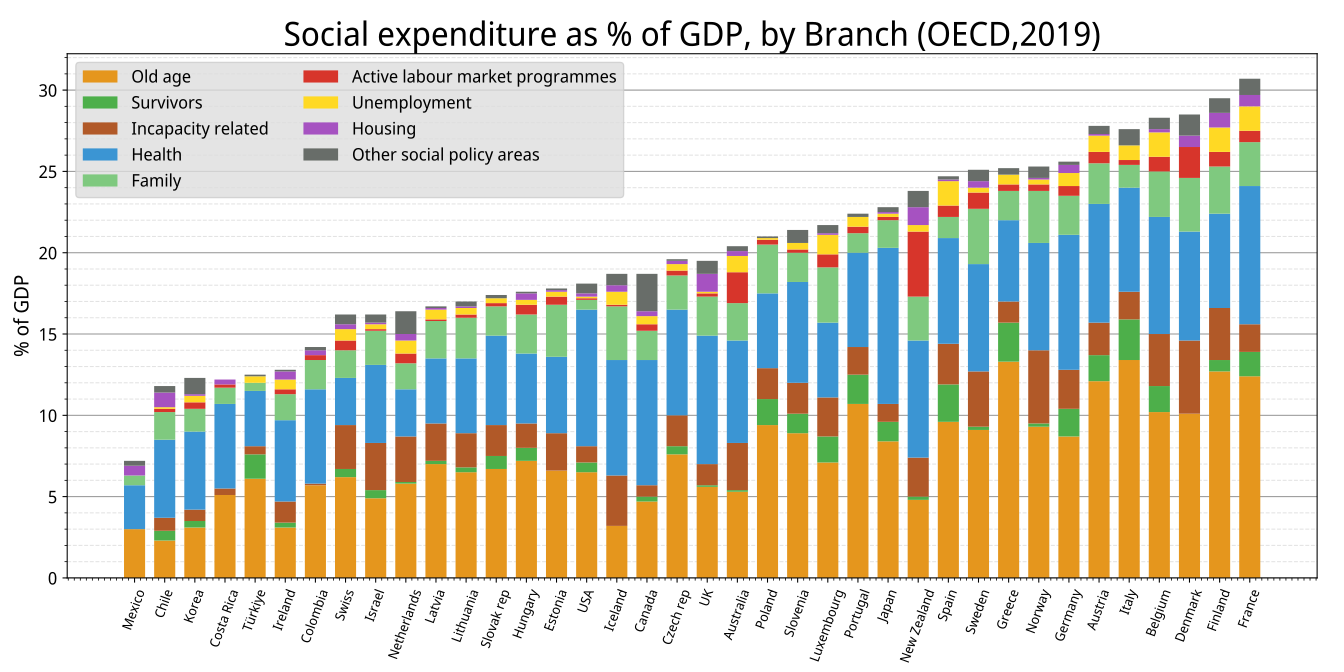
Globally, welfare state spending as a percentage of GDP varies dramatically, but often represents a significant portion of national budgets. The United States, for instance, spent around 22.7% of its GDP on social protection in 2022. The UK's NHS alone handles over 1 million patient-contacts every 36 hours. Pension systems, a cornerstone of welfare states, often aim to provide retirees with at least 60% of their pre-retirement income.
👥 Key People & Organizations
Key figures instrumental in shaping the welfare state include Otto von Bismarck, the German Chancellor who introduced the first comprehensive social insurance schemes in the 1880s. In the UK, William Beveridge's 1942 report laid the intellectual groundwork for the post-war welfare state, advocating for universal benefits to combat 'want, disease, ignorance, squalor, and idleness.' Franklin D. Roosevelt's New Deal in the United States, while not a full welfare state in the European sense, introduced foundational social security programs like the Social Security Act of 1935. Prominent organizations like the OECD play a crucial role in researching and comparing welfare state models globally, providing data that informs policy debates. Think tanks such as the Brookings Institution and the Resolution Foundation also contribute significantly to the discourse on welfare policy.
🌍 Cultural Impact & Influence
The welfare state has profoundly shaped modern societies, fostering greater social cohesion and reducing extreme poverty and inequality in many nations. It has normalized the idea that citizens have a right to a certain standard of living, influencing everything from educational attainment to public health outcomes. The widespread availability of public healthcare has demonstrably increased life expectancy and reduced infant mortality rates in countries with robust systems. Furthermore, the welfare state has influenced cultural norms around solidarity, collective responsibility, and the role of the state in individual lives. Its impact is visible in popular culture, from the aspirational narratives of social mobility to critiques of bureaucratic inefficiency, as seen in films and literature exploring the lives of those who rely on social services.
⚡ Current State & Latest Developments
In the early 21st century, welfare states are navigating significant challenges, including aging populations, rising healthcare costs, and the impact of globalization and automation on labor markets. Many countries are undertaking reforms to ensure the sustainability of their systems, often involving adjustments to pension ages, benefit levels, and the introduction of more targeted or conditional support. The COVID-19 pandemic placed unprecedented strain on welfare systems, highlighting their critical role in providing economic relief and healthcare access, while also exposing existing vulnerabilities. Debates are ongoing about the optimal balance between universalism and selectivity in benefits, and the role of private providers in delivering public services. Emerging trends include increased focus on 'active labor market policies' and 'social investment' strategies aimed at enhancing human capital and long-term employability.
🤔 Controversies & Debates
The welfare state is a perennial subject of debate, often framed as a tension between social solidarity and individual liberty, or between economic efficiency and social equity. Critics, often aligned with neoliberal or libertarian ideologies, argue that extensive welfare programs disincentivize work, foster dependency, and impose an unsustainable tax burden on productive citizens. They point to the potential for bureaucratic inefficiency and the erosion of individual responsibility. Conversely, proponents emphasize the welfare state's role in reducing poverty, mitigating inequality, and providing essential services that individuals cannot afford or access on their own. They argue that social safety nets are crucial for economic stability, promoting human capital development, and ensuring a more just and humane society. The debate also extends to the specific design of welfare programs, with ongoing arguments about the merits of universal basic income versus targeted benefits, and the extent of state versus market provision.
🔮 Future Outlook & Predictions
The future of the welfare state is likely to be shaped by ongoing demographic shifts, technological advancements, and evolving political ideologies. As populations age in many developed countries, the sustainability of pension and healthcare systems will remain a critical concern, potentially leading to further reforms and a greater emphasis on private savings and long-term care insurance. The rise of automation and artificial intelligence may necessitate new forms of income support, such as a universal basic income, to address potential widespread job displacement. Furthermore, the increasing recognition of climate change may lead to welfare policies that integrate environmental sustainability, such as 'green' social benefits or investments in renewable energy infrastructure. The ongoing tension between globalized markets and national welfare commitments will continue to drive policy innovation and political contestation.
💡 Practical Applications
Welfare state principles are applied across a vast array of practical domains. Public education systems, from kindergarten to university, are a cornerstone, aiming to provide equal learning opportunities. National healthcare services, like the NHS or Medicare in the US, offer medical treatment to citizens, often free at the point of use or heavily subsidized. Unemployment benefits provide temporary financial support to those who have los
Key Facts
- Category
- philosophy
- Type
- topic