
Contents
Overview
War and conflict represent the organized, often large-scale, use of armed force between states, groups, or factions, driven by a complex interplay of political, economic, ideological, and social factors. From the earliest tribal skirmishes to the global conflagrations of the 20th century and the asymmetric warfare of today, conflict has shaped human civilization, redrawing borders, forging empires, and leaving indelible scars on societies. Understanding war requires examining its origins, its mechanics, its devastating consequences, and the persistent human drive that fuels it, even as international efforts strive for peace and diplomacy.
🎵 Origins & History
The roots of war and conflict are as old as humanity itself, stretching back to prehistory. Early human societies likely engaged in conflict over resources, territory, and social dominance, mirroring patterns seen in other primate species. The concept of the 'just war' emerged in philosophical and theological traditions, notably with St. Augustine and later Thomas Aquinas, attempting to provide ethical frameworks for the initiation and conduct of hostilities, a debate that continues to this day.
⚙️ How It Works
Warfare operates through a complex system of organized violence, typically involving states or organized non-state actors. At its core, it relies on military strategy and tactics, the deployment of armed forces, and the application of technology to achieve objectives, which can range from territorial conquest and resource acquisition to political subjugation and ideological imposition. Modern warfare often involves intricate logistics, intelligence gathering, and command structures. The nature of conflict continues to evolve, with the rise of cyber warfare, drone warfare, and hybrid warfare challenging traditional notions of battlefield engagement.
📊 Key Facts & Numbers
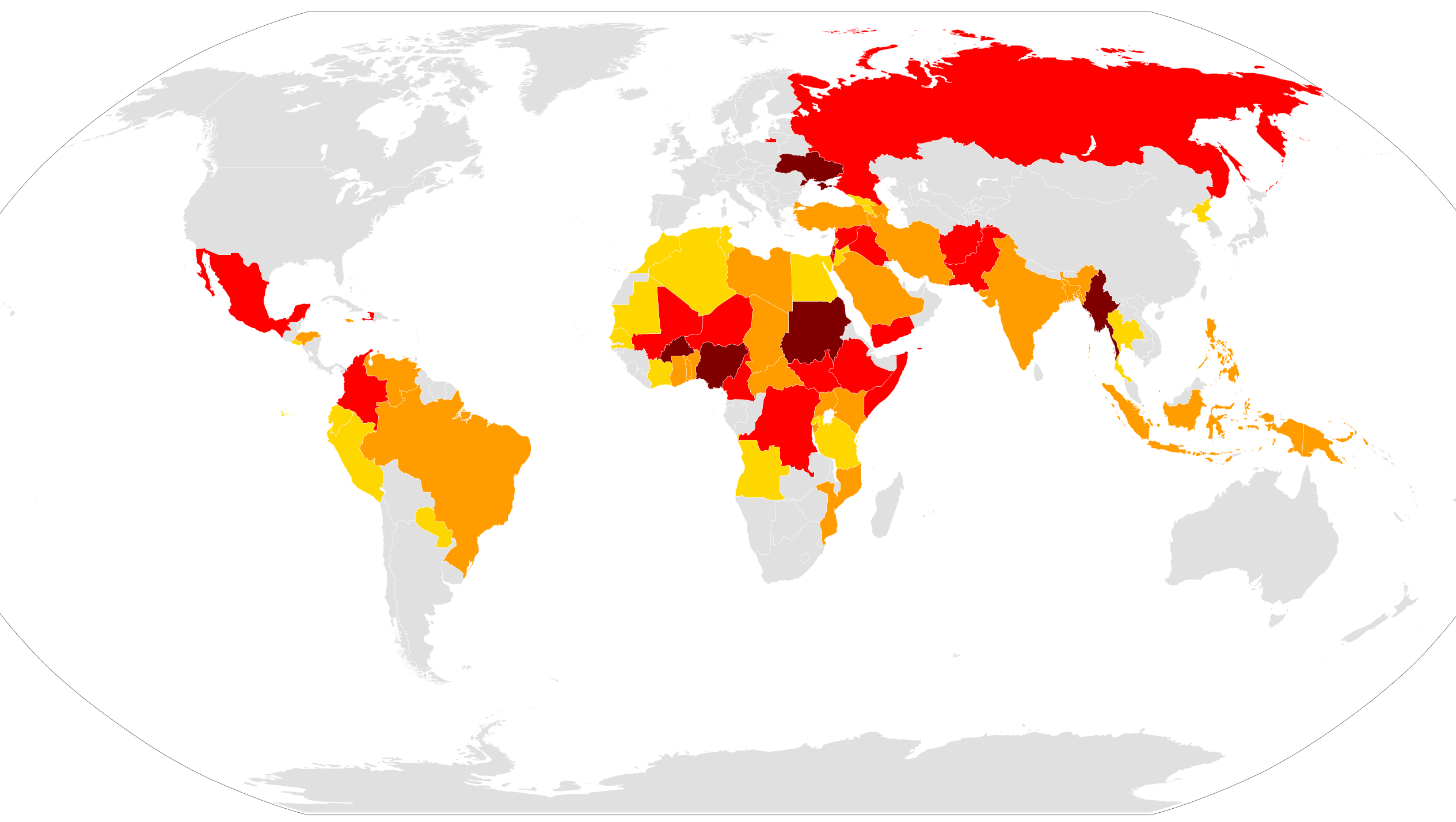
The sheer scale of human loss due to war is staggering. The economic costs are equally immense. Military spending globally reached an all-time high in 2023, according to the Stockholm International Peace Research Institute (SIPRI). The number of refugees and internally displaced persons globally surpassed 110 million in 2023, largely driven by ongoing conflicts in regions like Ukraine and Sudan.
👥 Key People & Organizations
Throughout history, countless individuals and organizations have shaped the course of war and conflict. Military leaders like Alexander the Great, Genghis Khan, and Napoleon Bonaparte revolutionized military strategy. Political figures such as Otto von Bismarck and Winston Churchill wielded war as a tool of statecraft. Thinkers like Carl von Clausewitz, author of 'On War', provided foundational theories on the nature of conflict. Modern organizations like the United Nations (UN) were established with the primary goal of preventing future wars, while bodies like the North Atlantic Treaty Organization (NATO) serve as collective defense alliances. Non-state actors, such as Hamas and the Taliban, also play significant roles in contemporary conflicts.
🌍 Cultural Impact & Influence
War and conflict have profoundly influenced human culture, art, and society. Epic poems like Homer's Iliad and historical accounts like Thucydides' 'History of the Peloponnesian War' have served as foundational texts for understanding conflict. The visual arts have depicted battles and their aftermath, from Paolo Uccello's 'The Battle of San Romano' to the stark photography of Robert Capa. Literature and film have explored the psychological toll of war, with works like All Quiet on the Western Front and films like 'Saving Private Ryan' offering visceral portrayals of combat. Conversely, periods of peace and stability following major conflicts have often spurred innovation and cultural flourishing, as seen in the Renaissance following the Italian Wars or the technological boom after World War II.
⚡ Current State & Latest Developments
The rise of transnational terrorist groups like ISIS and Al-Qaeda continues to pose a threat in various regions, often operating through asymmetric tactics and exploiting political instability. The increasing prevalence of disinformation campaigns and information warfare further complicates the landscape of modern conflict.
🤔 Controversies & Debates
The very definition and justification of war are subjects of intense debate. The Just War Theory continues to be a focal point, with ongoing discussions about criteria for jus ad bellum (justice in going to war) and jus in bello (justice in conducting war). Critics argue that the theory is often selectively applied or ignored by powerful states. The ethics of autonomous weapons systems (killer robots) raise profound questions about accountability and the dehumanization of warfare. Furthermore, the role of economic sanctions as a tool of conflict, and their impact on civilian populations, is a persistent point of contention. The debate over humanitarian intervention, as seen in Libya in 2011, highlights the tension between national sovereignty and the responsibility to protect populations from mass atrocities.
🔮 Future Outlook & Predictions
The future of war and conflict is likely to be shaped by several key trends. The continued proliferation of advanced military technologies, including artificial intelligence in warfare, hypersonic missiles, and sophisticated cyber capabilities, could lead to faster, more destructive, and less predictable conflicts. The potential for great power competition, particularly between the United States, China, and Russia, raises concerns about large-scale interstate warfare, though the specter of nuclear escalation may act as a deterrent. Conversely, the increasing interconnectedness of the global economy and the shared threat of climate change could foster greater cooperation, potentially mitigating some drivers of conflict. The effectiveness of international institutions like the UN Security Council in preventing or resolving conflicts will also be a critical factor.
💡 Practical Applications
While war and conflict are inherently destructive, understanding their mechanics and history has practical applications. Military strategy and tactics developed over centuries inform modern defense planning and geopolitical analysis. The study of conflict resolution and peacebuilding, pioneered by figures like Johan Galtung, provides frameworks for de-escalating tensions and foster
Key Facts
- Category
- history
- Type
- topic