
Contents
- 🎵 What Are Time Signatures, Really?
- 📏 The Anatomy of a Time Signature
- ⚖️ Common Time Signatures and Their Vibe
- 🧮 Odd Time Signatures: The Rebels of Rhythm
- 🤔 Time Signatures vs. Rhythm: A Crucial Distinction
- 💡 How Time Signatures Shape Musical Feel
- 📈 The Evolution of Time Signatures
- 🏆 Time Signatures in Different Genres
- ❓ Common Misconceptions About Time Signatures
- 🚀 Advanced Concepts and Further Exploration
- 📚 Resources for Mastering Time Signatures
- 💡 Your Next Steps with Time Signatures
- Frequently Asked Questions
- Related Topics
Overview
A time signature is the bedrock of rhythmic organization in Western music notation. It's not just a mathematical fraction; it's the conductor's baton for the pulse of a piece, dictating the number of beats per measure and the type of note value that constitutes one beat. Think of it as the blueprint for how musical phrases are structured, providing a framework that composers and performers alike rely on to create coherent and compelling sonic narratives. Without it, music would devolve into a chaotic free-for-all, lacking the predictable ebb and flow that makes it so engaging.
📏 The Anatomy of a Time Signature
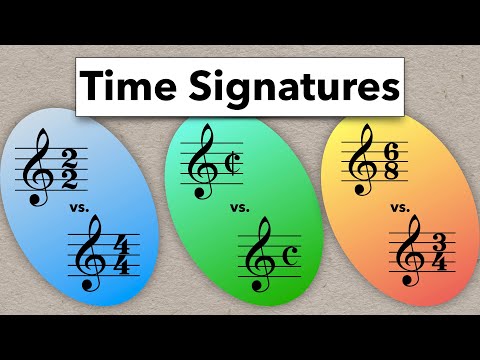
At its most basic, a time signature is presented as two numbers, stacked vertically. The top number, the numerator, tells you how many beats are in each measure. The bottom number, the denominator, specifies what kind of note gets one beat. For instance, in 4/4 time, there are four beats per measure, and a quarter note receives one beat. This seemingly simple notation is the key to unlocking the rhythmic identity of a musical work, influencing everything from its perceived speed to its overall character. Understanding this fundamental structure is the first step to deciphering any musical score.
⚖️ Common Time Signatures and Their Vibe
The most ubiquitous time signatures are 4/4 (common time) and 3/4 (waltz time). 4/4, often symbolized by a 'C', feels like a steady march, the backbone of countless pop, rock, and classical pieces. 3/4, with its characteristic 'oom-pah-pah' feel, defines the elegance of a waltz or the melancholy of a ballad. Other common signatures like 2/4 (a brisk march) and 6/8 (often feeling like two groups of three eighth notes, common in jigs and lullabies) offer distinct rhythmic flavors. Each common time signature has a deeply ingrained cultural association that influences listener expectations.
🧮 Odd Time Signatures: The Rebels of Rhythm
Odd time signatures are where musical creativity truly stretches its legs. Signatures like 5/4 (famously used in Dave Brubeck's 'Take Five'), 7/8, or even more complex arrangements like 11/8, challenge conventional rhythmic expectations. These meters often create a sense of unease, intrigue, or a propulsive, asymmetrical drive. Composers like Igor Stravinsky and progressive rock bands like King Crimson have masterfully employed these meters to create unique sonic landscapes, pushing the boundaries of what listeners perceive as 'normal' rhythm. They are the spice that can elevate a piece from the ordinary to the extraordinary.
🤔 Time Signatures vs. Rhythm: A Crucial Distinction
It's crucial to distinguish between a time signature and rhythm itself. The time signature is the overarching organizational principle, the container. Rhythm, on the other hand, is the specific pattern of durations and accents within that container. A 4/4 time signature can accommodate an infinite variety of rhythmic patterns, from simple, steady beats to complex syncopations. Conversely, a complex rhythmic pattern can be written in a simple time signature. Confusing the two is a common pitfall for aspiring musicians and theorists, leading to a misunderstanding of how musical time is actually constructed.
💡 How Time Signatures Shape Musical Feel
The perceived 'feel' of a piece is profoundly shaped by its time signature. 4/4 often lends itself to a strong, grounded, and often danceable pulse. 3/4 evokes grace, flow, and a sense of gentle sway. 6/8, with its compound meter, can feel more flowing and less rigidly divided than a simple meter like 4/4. The placement of accents, dictated by the composer and interpreted by the performer, further refines this feel. A time signature is not just a technical instruction; it's an emotional cue, guiding the listener's experience and shaping their subconscious response to the music.
📈 The Evolution of Time Signatures
Historically, the concept of fixed measures and time signatures evolved gradually. Early Gregorian chant was largely unmetered. The development of polyphony in the medieval and Renaissance periods necessitated more structured rhythmic organization. The Baroque era saw a greater standardization, with composers like Johann Sebastian Bach solidifying the use of common time signatures. The 20th and 21st centuries, however, have witnessed a deliberate exploration and expansion of rhythmic possibilities, with composers actively experimenting with and inventing new meters and time signatures.
🏆 Time Signatures in Different Genres
Different musical genres have distinct relationships with time signatures. Classical music, while often rooted in common meters, features extensive use of odd and changing meters in later periods. Jazz, particularly in its modern forms, embraces complex rhythms and often features syncopation within standard time signatures, alongside explorations of less common meters. Rock and pop music predominantly stick to 4/4, but exceptions abound, with progressive rock and math rock genres being notable for their adventurous use of varied and odd time signatures. Folk music often retains traditional meters like 3/4 and 6/8.
❓ Common Misconceptions About Time Signatures
A persistent misconception is that a time signature dictates the tempo. This is incorrect; tempo refers to the speed of the beat, usually indicated by metronome markings (e.g., quarter note = 120 bpm). A time signature dictates the organization of beats within a measure, not how fast those beats occur. Another common error is assuming that all music in 6/8 has a 'slow' feel; while often used for ballads, 6/8 can also be played at very fast tempos, maintaining its characteristic compound subdivision. Understanding these distinctions is vital for accurate musical analysis.
🚀 Advanced Concepts and Further Exploration
Beyond the basic numerator-denominator system, composers can employ changing time signatures within a single piece, creating dynamic rhythmic shifts. Polymeter, the simultaneous use of two or more different time signatures, offers another layer of complexity, often creating a disorienting yet fascinating effect. Asymmetrical meters, where beats are grouped unevenly (e.g., 2+3+2 eighth notes in 7/8), are a sophisticated way to build rhythmic tension and interest. Exploring these advanced concepts reveals the vast potential for rhythmic innovation.
📚 Resources for Mastering Time Signatures
To truly master time signatures, practical application is key. Begin by analyzing the time signatures of your favorite songs using resources like Ultimate Guitar or Sheet Music Direct. Practice clapping or tapping out rhythms in various meters. Consider taking a music theory course that covers rhythmic notation in depth. Engaging with rhythm trainers and metronome apps can also solidify your understanding. The goal is to internalize these structures so they become intuitive.
💡 Your Next Steps with Time Signatures
Ready to unlock the rhythmic secrets of music? Start by identifying the time signature of a song you love. Try to feel the pulse and count the beats. Then, experiment with playing or singing along, paying close attention to how the rhythm fits within that established meter. Don't be afraid to explore music known for its rhythmic complexity; it's often in the challenges that the greatest learning occurs. Your journey into the world of time signatures has just begun, and the rhythmic possibilities are endless.
Key Facts
- Year
- 2023
- Origin
- Ancient Music Theory
- Category
- Music Theory
- Type
- Concept
Frequently Asked Questions
Is 4/4 the most common time signature?
Yes, 4/4, also known as common time, is by far the most prevalent time signature in Western music. Its prevalence spans across genres from classical to pop, rock, and jazz. This is largely due to its natural, balanced feel, which is easy to follow and dance to. Its ubiquity makes it a foundational element for anyone learning music theory or composition.
How do I identify the time signature of a song?
You can often identify a song's time signature by listening for the main pulse and counting the beats within each recurring phrase or 'bar'. For 4/4, you'll typically feel four distinct beats. For 3/4, you'll feel a three-beat pattern, like a waltz. If you have access to the sheet music, the time signature is explicitly written at the beginning of the piece, usually after the clef and key signature. Online music databases also frequently list the time signature.
What's the difference between time signature and tempo?
The time signature dictates the rhythmic organization of a piece—how many beats are in a measure and what note value gets one beat. Tempo, on the other hand, refers to the speed of the music, how fast or slow those beats are played. A piece in 4/4 can be played at a slow tempo (like a ballad) or a fast tempo (like a punk rock song), but the underlying structure of four beats per measure remains the same.
Are odd time signatures difficult to play?
Odd time signatures, such as 5/4 or 7/8, can be challenging initially because they deviate from the familiar, symmetrical patterns of common meters. They require a different way of conceptualizing and feeling the beat. However, with practice and focused listening, musicians can become adept at navigating these meters. Many musicians find them creatively stimulating once they've internalized the rhythmic feel.
Can a song change time signatures?
Absolutely. Composers frequently use changing time signatures within a single piece to create variety, build tension, or emphasize specific musical ideas. This technique, known as changing meter, can add a dynamic and unpredictable quality to the music. It's a common feature in progressive rock, jazz fusion, and contemporary classical music.
What is compound meter?
Compound meter, like 6/8 or 9/8, divides each beat into three subdivisions, rather than two as in simple meter (like 4/4). In 6/8, for example, there are two main beats, each subdivided into three eighth notes, giving it a characteristic 'swing' or 'lilting' feel. This contrasts with simple meters where each beat is divided into two. Understanding this subdivision is key to correctly interpreting compound time signatures.