
Contents
Overview
The intellectual roots of the Single Transferable Vote stretch back to the mid-19th century, with significant contributions from figures like Thomas Hare and Carl Henrik von Boehr. Hare's 1857 pamphlet, 'A Treatise on the Election of Representatives,' laid out a comprehensive plan for a quota-based system that would allow voters to express preferences across a wide field of candidates, ensuring that a candidate could be elected with a fraction of the total votes if they achieved a certain threshold. Boehr, a Danish politician, independently developed similar ideas around the same time. The system was first implemented in Tasmania, Australia, in 1907 for legislative council elections, marking a pivotal moment in its practical application. Later, it was adopted by the Irish Free State in 1921 for its parliamentary elections, solidifying its place as a viable, albeit complex, electoral mechanism.
⚙️ How It Works
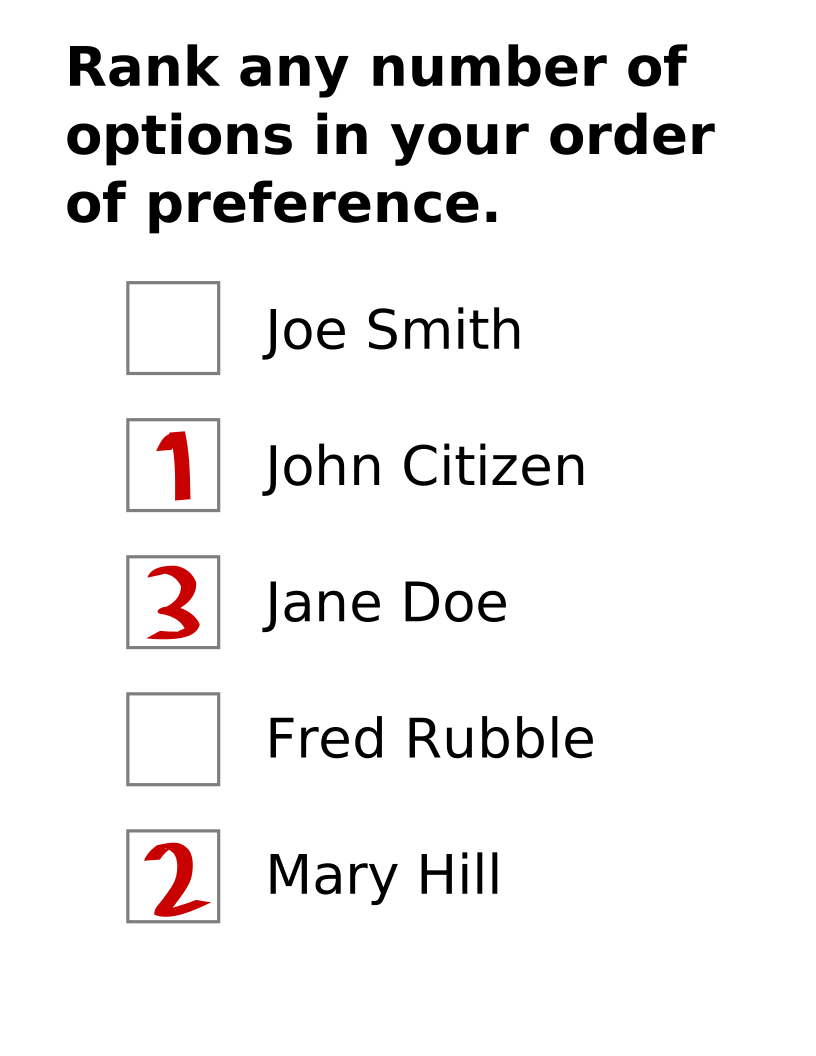
At its core, STV operates by first establishing a 'quota' – the minimum number of votes required to win a seat. A common method is the Droop quota, calculated as (Total Votes / (Seats + 1)) + 1. Votes are counted for the first preferences. If a candidate reaches the quota, they are declared elected. Any surplus votes they received (votes beyond the quota) are then transferred to the voter's next preferred candidate, according to a specific formula that maintains the proportional value of those surplus votes. If no candidate reaches the quota, or after surplus transfers, the candidate with the fewest votes is eliminated, and their votes are transferred to the voter's next preference. This process continues until all seats are filled, ensuring that each vote contributes to the election of a representative.
📊 Key Facts & Numbers
Globally, STV is employed in various levels of elections, from national parliaments to local councils. In Australia, STV is used for the Australian Senate and for elections in Tasmania, where it has been in continuous use since 1907. Malta has used STV for its parliamentary elections since 1921, electing 65 members of parliament. The system is also utilized in local elections in New Zealand and for some elections in the United States, such as in Minneapolis and Oakland, California, for city council and mayoral races. Approximately 10% of the world's national parliamentary elections utilize some form of proportional representation, with STV being a significant, though not dominant, method within that category.
👥 Key People & Organizations
Key figures instrumental in the development and advocacy of STV include Thomas Hare, whose 1857 treatise provided the foundational principles, and C. Lyons Upton, who refined the mathematical aspects of vote transfer. E. R. Li-Ru-Li was a prominent advocate in the early 20th century. Organizations like the Electoral Reform Society in the UK and the FairVote organization in the United States actively promote STV and other forms of ranked-choice voting. In Ireland, the system has been integral to the functioning of its multi-party democracy since its adoption by the Fine Gael-led government in 1921.
🌍 Cultural Impact & Influence
STV has profoundly influenced the discourse on electoral reform and democratic fairness. Its adoption in countries like Ireland and Malta has fostered multi-party systems and coalition governments, often leading to more consensus-driven politics compared to first-past-the-post systems. The system's emphasis on voter preference and minimizing wasted votes has resonated with reform movements worldwide, including the Occupy movement and various grassroots campaigns advocating for more representative outcomes. The visual representation of vote transfers in STV, often depicted through complex flowcharts, has also become a cultural touchstone for understanding the intricacies of proportional representation.
⚡ Current State & Latest Developments
As of 2024, STV continues to be a subject of active debate and implementation. Several cities in the United States, notably in Maine and Alaska, have adopted ranked-choice voting (RCV) for single-winner elections, which shares some principles with STV but is distinct. However, the push for multi-winner STV in the U.S. faces significant political hurdles, despite advocacy from groups like FairVote. In Europe, discussions around electoral reform often include STV as a potential model for achieving better proportionality, particularly in countries grappling with fragmented party systems or low voter turnout.
🤔 Controversies & Debates
The primary controversy surrounding STV centers on its complexity. Critics argue that the ranking of candidates and the subsequent vote transfers can be confusing for voters, potentially leading to lower engagement or misinterpretation of results. Skeptics also question whether STV truly achieves perfect proportionality, pointing to instances where the seat allocation might not perfectly mirror vote share due to the quota system and the elimination process. Conversely, proponents highlight that while complex, the system empowers voters to express nuanced preferences and ensures that a broader spectrum of political views is represented, leading to more stable and legitimate governments.
🔮 Future Outlook & Predictions
The future of STV likely lies in continued advocacy and incremental adoption, particularly in jurisdictions seeking to enhance democratic representation. As digital voting technologies advance, the perceived complexity of STV might diminish, potentially paving the way for wider acceptance. Experts predict that as dissatisfaction with traditional electoral systems grows, STV could see increased consideration, especially in local and regional elections where its benefits in fostering diverse representation are most apparent. The ongoing debate around electoral reform in the United States and other democracies suggests that STV remains a potent, albeit challenging, option for the future.
💡 Practical Applications
STV is most practically applied in multi-member electoral districts where proportional representation is desired. This includes national parliamentary elections, as seen in Malta and Ireland, and regional legislative bodies. Many local governments, such as those in parts of New Zealand and several U.S. cities like Burlington, Vermont, use STV or similar ranked-choice systems for council elections. It's also employed by various organizations and professional bodies for internal elections to ensure a representative distribution of opinions among their members.
Key Facts
- Category
- technology
- Type
- concept