Ottoman Empire Legacy | Vibepedia
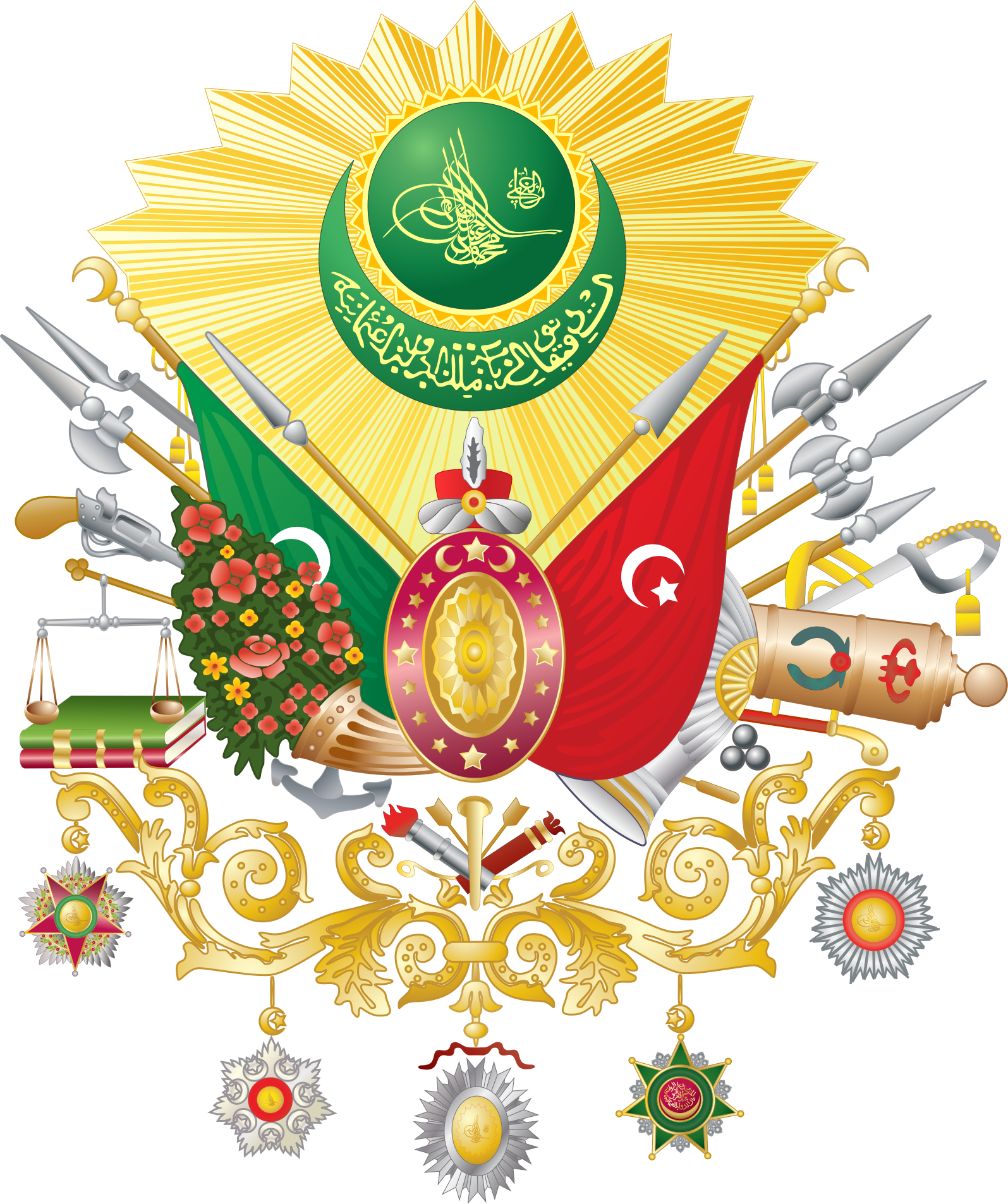
The Ottoman Empire, a colossal power that spanned over six centuries, left an indelible mark on the geopolitical, cultural, and architectural landscapes of…
Contents
Overview
The Ottoman Empire, a colossal power that spanned over six centuries, left an indelible mark on the geopolitical, cultural, and architectural landscapes of Southeastern Europe, Western Asia, and North Africa. Its legacy is a complex tapestry woven from threads of imperial administration, military prowess, religious influence, and artistic innovation. From the conquest of Constantinople in 1453 by Sultan Mehmed II to its eventual dissolution after World War I, the empire's administrative structures, legal systems, and vast trade networks profoundly influenced the regions it governed. The echoes of its governance, particularly in the Balkans and the Middle East, continue to shape contemporary national identities and political dynamics. Its architectural marvels, like the Hagia Sophia and the Süleymaniye Mosque, stand as testaments to its grandeur and sophisticated craftsmanship, influencing architectural styles for centuries. The empire's role as a bridge between East and West, its patronage of the arts and sciences, and its complex relationship with religious and ethnic diversity all contribute to its multifaceted and often debated historical significance.
🎵 Origins & History
The Ottoman Empire's genesis is shrouded in legend, but its historical trajectory began around 1299 with Osman I, a chieftain of the Kayı tribe in Anatolia. Initially a small beylik, it rapidly expanded through military conquest, absorbing Byzantine territories and other Turkish principalities. The pivotal moment arrived in 1453 when Sultan Mehmed II conquered Constantinople, transforming it into the imperial capital, Istanbul, and marking the empire's ascent to major world power status. For over 600 years, the dynasty, tracing its lineage to Osman, ruled, establishing a vast empire that at its zenith stretched from the gates of Vienna to the Persian Gulf and across North Africa. The Ottoman administrative center shifted from Söğüt to Bursa, then to Edirne, and finally to Istanbul, each move signifying a stage in its consolidation and expansion.
⚙️ How It Worked
The Ottoman administrative system was a sophisticated, hierarchical structure designed to govern a vast, multi-ethnic, and multi-religious territory. At its apex was the Sultan, an absolute monarch who also held the title of Caliph, the spiritual leader of Sunni Muslims. The Devshirme system was a unique method of recruiting Christian boys who were converted to Islam and trained for military or administrative service, forming the elite Janissary corps and filling key bureaucratic roles. The Millet system allowed religious communities significant autonomy in managing their own affairs, including education and personal law, under their respective religious leaders. This decentralized approach, while fostering a degree of internal cohesion, also contributed to the empire's eventual fragmentation.
📊 Key Facts & Numbers
The Ottoman Empire commanded a vast territory and population. Its administrative structures and military forces required significant resources. The Janissary corps, the elite infantry, were a key component of the Ottoman military. The empire's control over trade routes was significant before the Age of Discovery. By the early 20th century, however, its territorial extent had shrunk dramatically, losing significant portions of its European territories.
👥 Key Figures & Institutions
The Ottoman Empire was shaped by a succession of powerful Sultans and influential institutions. Osman I is credited as the founder, while Suleiman the Magnificent presided over the empire's golden age, known for legal reforms and military expansion. The Janissary corps were the empire's elite military force, though they later became a destabilizing political power. The Devshirme system provided a constant influx of talent into the administration and military. The Ulema, the body of Islamic scholars, played a crucial role in interpreting Islamic law and advising the Sultan. The Grand Vizier was the chief minister, wielding considerable power in governing the empire's day-to-day affairs.
🌍 Cultural Impact & Influence
The Ottoman legacy is profoundly visible in the architecture of its former territories, with iconic structures like the Hagia Sophia in Istanbul, the Sultan Ahmed Mosque (Blue Mosque), and numerous mosques, bridges, and caravanserais dotting the Balkans and the Middle East. Ottoman cuisine, a fusion of Turkic, Persian, and Arab influences, remains a cornerstone of culinary traditions in many countries. The empire's legal and administrative frameworks influenced the development of modern states in the region, and its role as a major Islamic power shaped religious discourse and practice for centuries. The concept of a multi-ethnic, multi-religious empire, though ultimately unsustainable, offers a historical counterpoint to modern nation-state models.
⚡ Current State & Latest Developments
In the 21st century, the Ottoman legacy continues to be a subject of academic study and public fascination, particularly in Turkey and the Balkan states. Contemporary Turkish foreign policy often invokes historical ties and influences stemming from the Ottoman era, particularly in relations with countries like Azerbaijan and Qatar. Debates surrounding the Armenian Genocide, a tragic event that occurred during the empire's final years under the Committee of Union and Progress (CUP) government, remain a significant point of contention. The resurgence of interest in Ottoman history is also evident in popular culture, with historical dramas like 'Magnificent Century' achieving widespread viewership, sparking renewed discussions about the empire's past.
🤔 Controversies & Debates
The Ottoman Empire's legacy is fraught with controversy. The treatment of minority populations, particularly the Armenian Genocide (1915-1917), remains a deeply divisive issue, with Turkey officially denying the genocide, while a vast majority of historians and numerous countries recognize it as such. The empire's long history of warfare, including the sieges of Vienna and its involvement in World War I on the side of the Central Powers, is a subject of ongoing historical debate. Furthermore, the legacy of the Devshirme system and the Janissaries, while integral to Ottoman power, also involved coercion and violence, complicating their historical portrayal. The empire's role in the slave trade and its interactions with European colonial powers also present a complex and often uncomfortable historical narrative.
🔮 Future Outlook & Predictions
The future interpretation of the Ottoman legacy will likely be shaped by ongoing geopolitical shifts and evolving national narratives. As Turkey asserts its regional influence, historical connections to the Ottoman past may be re-emphasized, potentially leading to renewed debates about imperial identity and responsibility. In the Balkans, the legacy of Ottoman rule continues to influence ethnic relations and political discourse, with differing historical memories contributing to contemporary tensions. Academic research is likely to continue exploring the empire's administrative innovations, its cultural syntheses, and the experiences of its diverse populations, offering new perspectives on its long-term impact. The digital humanities are also poised to play a larger role, with initiatives to digitize Ottoman archives and make them more accessible to global researchers.
💡 Practical Applications
The practical applications of studying the Ottoman Empire's legacy are manifold, particularly in understanding contemporary geopolitical dynamics. The administrative structures and legal precedents established by the Ottomans offer insights into governance models for diverse populations, relevant to current discussions on federalism and minority rights. The empire's role as a major trade intermediary between East and West provides valuable lessons for understanding historical globalization and the evolution of international commerce. Furthermore, the study of Ottoman military organization and strategy offers historical context for military history and strategic studies. The empire's complex interactions with European powers also serve as a case study for understanding historical diplomacy and the dynamics of imperial decline.
Key Facts
- Category
- history
- Type
- topic