
Contents
Overview
The genesis of NASA's Mars exploration can be traced back to the early days of the Space Race, fueled by a desire to understand our planetary neighbor and a burgeoning scientific curiosity. Initial efforts in the 1960s, such as the Mariner program, provided the first close-up images of Mars, revealing a cratered, seemingly barren world. The Viking program in the 1970s marked a significant leap, with landers attempting to detect life, though their results remain debated. The late 20th century saw a renewed focus with missions like Mars Pathfinder and its Sojourner rover, demonstrating the feasibility of surface exploration. This period laid the groundwork for the ambitious robotic explorers that would follow, each building upon the knowledge and technological advancements of its predecessors, driven by a persistent, almost romantic, fascination with the possibility of life beyond Earth.
⚙️ How It Works
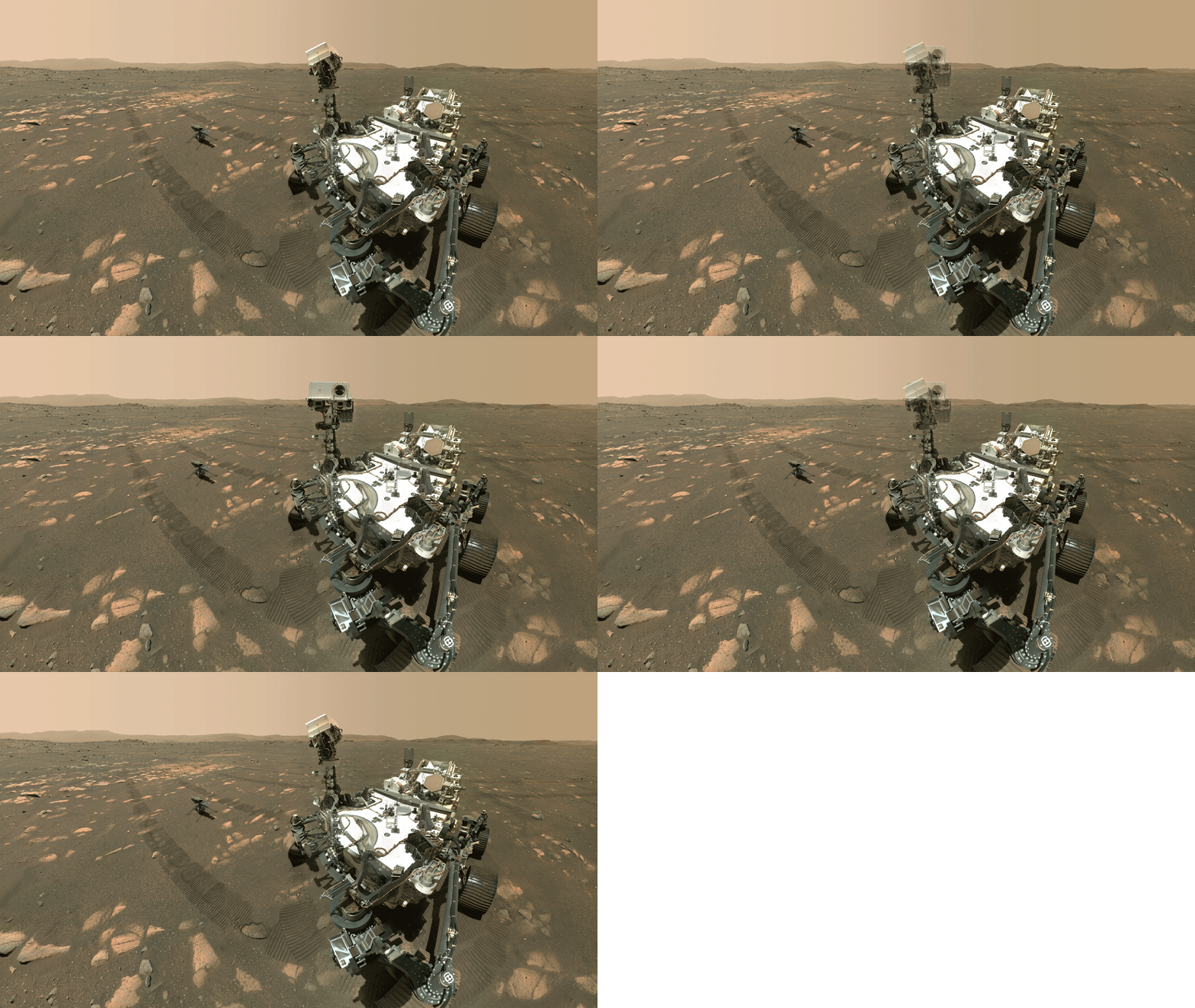
NASA's Mars exploration missions operate on a complex interplay of orbital reconnaissance, atmospheric entry, descent, and landing (EDL), and surface operations. Orbiters, like the Mars Reconnaissance Orbiter (MRO), act as crucial communication relays and high-resolution imagers, mapping the planet and identifying potential landing sites. The EDL phase is notoriously challenging, often dubbed the 'seven minutes of terror,' involving heat shields, parachutes, retrorockets, and sky cranes to safely deliver payloads to the surface. Once landed, rovers such as Curiosity and Perseverance utilize sophisticated scientific instruments—spectrometers, cameras, drills—to analyze rock and soil composition, search for organic molecules, and study the Martian environment. These robotic geologists are essentially mobile laboratories, transmitting vast amounts of data back to Earth for analysis by scientists at institutions like the Jet Propulsion Laboratory (JPL).
📊 Key Facts & Numbers
The Mars Exploration Rovers, Spirit and Opportunity, far exceeded their planned 90-day missions, operating for 6 and nearly 15 years respectively, demonstrating remarkable engineering resilience. The Perseverance rover, alone, carries a payload of seven scientific instruments and has collected over 20 rock and regolith samples for potential return to Earth.
👥 Key People & Organizations
The architects of NASA's Mars exploration are a constellation of brilliant minds and dedicated institutions. Wernher von Braun, a visionary rocket scientist, was instrumental in early conceptualizations of interplanetary travel, including missions to Mars. Elizabeth Crump played a key role in the early Mariner missions. More recently, figures like Ken Bowman, former director of JPL, and Thomas Zurbuchen, former Associate Administrator for the Science Mission Directorate at NASA Headquarters, have overseen critical phases of Mars exploration. Key organizations include the Jet Propulsion Laboratory (JPL), which manages most of NASA's robotic interplanetary missions, and numerous universities and research institutions that contribute scientific expertise and instrument development. The Space Science Institute has also been a significant contributor to mission planning and data analysis.
🌍 Cultural Impact & Influence
NASA's Mars exploration has profoundly shaped humanity's perception of our place in the cosmos and fueled a cultural fascination with the Red Planet. From the iconic images of Martian landscapes captured by Viking and Pathfinder to the compelling narratives of rovers like Curiosity and Perseverance, Mars has become a constant presence in popular culture. It has inspired countless science fiction novels, films like 'The Martian,' and video games, often exploring themes of survival, discovery, and the future of humanity. The search for life on Mars, even if ultimately unsuccessful, has pushed philosophical boundaries, forcing us to confront the possibility of extraterrestrial existence and our own uniqueness. This ongoing exploration has also fostered a sense of global unity, as missions often involve international collaboration and capture the imagination of people worldwide.
⚡ Current State & Latest Developments
The current era of NASA's Mars exploration is characterized by the highly successful Perseverance mission, which is actively seeking signs of ancient microbial life in the Jezero Crater and collecting samples for a future Mars Sample Return campaign, a joint effort with the European Space Agency (ESA). The MRO continues to provide invaluable data and imagery, while the Curiosity rover is still actively exploring Gale Crater, exceeding its planned mission duration. The InSight lander, though its mission concluded in late 2022 due to dust accumulation on its solar panels, provided unprecedented seismic data about Mars' interior. Looking ahead, NASA is actively developing technologies and mission concepts for eventual human exploration, including advanced propulsion systems and life support technologies.
🤔 Controversies & Debates
The exploration of Mars is not without its controversies and debates. A persistent point of contention is the high mission failure rate, leading to questions about the cost-effectiveness and risk management of interplanetary missions. The interpretation of data, particularly regarding potential biosignatures or evidence of past life, has also sparked scientific debate; for instance, the Viking lander experiments' ambiguous results continue to be re-examined. Furthermore, the ethical implications of planetary protection—ensuring that Earth microbes don't contaminate Mars and vice versa—are a constant concern, especially as human missions become more plausible. The debate over the prioritization of robotic versus human exploration also continues, with some arguing that resources could be better allocated to further robotic science or other terrestrial priorities.
🔮 Future Outlook & Predictions
The future of NASA's Mars exploration is undeniably geared towards human presence. The ambitious Mars Sample Return mission, aiming to bring samples collected by Perseverance back to Earth for detailed analysis, is a critical stepping stone. Beyond that, the development of technologies for sustained human habitation, including in-situ resource utilization (ISRU) to produce water and oxygen from Martian resources, is paramount. Concepts for advanced propulsion systems, such as nuclear thermal or electric propulsion, are being explored to reduce transit times. While specific timelines remain fluid, the scientific and engineering communities largely anticipate the first human footsteps on Mars within the next two decades, marking a new epoch in space exploration and potentially answering the age-old question of whether we are alone in the universe.
💡 Practical Applications
The technologies and scientific knowledge gained from Mars exploration have numerous practical applications. Advancements in miniaturization, robotics, and remote sensing developed for Mars missions have found their way into terrestrial applications, including medical imaging, disaster response robots, and environmental monitoring. The development of life support systems for long-duration spaceflight has implications for sustainable living technologies on Earth. Furthermore, the study of Martian geology and atmospheric processes provides valuable comparative data for un
Key Facts
- Category
- science
- Type
- topic