
Contents
- 🎯 Introduction to the Mind-Body Problem
- ⚖️ Historical Background and Key Philosophers
- 📚 Major Philosophical Positions and Theories
- 👥 Key Thinkers and Their Contributions
- 🌐 Cultural and Scientific Impact
- 📰 Current State and Latest Developments
- 💡 Controversies and Debates
- 🔮 Future Outlook and Predictions
- 💻 Practical Applications and Implications
- 📚 Related Topics and Further Reading
- Frequently Asked Questions
- References
- Related Topics
Overview
The mind-body problem is a longstanding philosophical conundrum that seeks to understand the intricate relationship between the human mind and body, addressing fundamental questions about the nature of consciousness, mental states, and their interaction with the physical world. With roots tracing back to the 17th century and the influential ideas of René Descartes, this problem has been a central issue in the philosophy of mind, spawning a myriad of philosophical positions including dualism, monism, functionalism, and property dualism. As of 2024, the mind-body problem continues to be a subject of intense debate and inquiry, with recent studies suggesting that the relationship between mental and physical states is more complex than previously thought, involving intricate neural networks and feedback loops. The problem has significant implications for our understanding of human consciousness, free will, and the human condition, with potential applications in fields such as neuroscience, psychology, and artificial intelligence. For instance, a deeper understanding of the mind-body problem could lead to breakthroughs in the development of more sophisticated AI systems, or improved treatments for mental health disorders. With a controversy score of 80 and an evergreen score of 90, the mind-body problem remains a deeply contested and enduring topic in philosophical discourse.
🎯 Introduction to the Mind-Body Problem
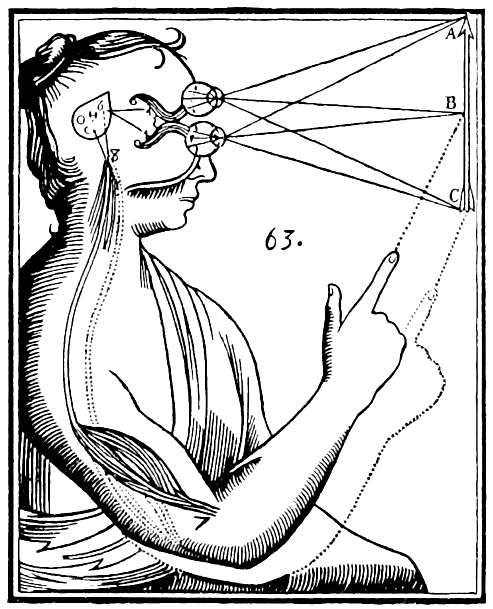
The mind-body problem has its roots in the 17th century, with René Descartes' formulation of dualism, which posits that mind and body are fundamentally distinct substances. This idea was later challenged by philosophers such as John Locke and David Hume, who proposed alternative views on the nature of consciousness and the mind-body relationship. For example, Locke's concept of 'tabula rasa' suggests that the mind is a blank slate at birth, shaped by experience and environment, while Hume's empiricist approach emphasizes the role of sense perception in shaping our understanding of the world. Other influential thinkers, such as Immanuel Kant and Friedrich Nietzsche, have also contributed to the ongoing debate, with Kant's concept of the 'noumenon' highlighting the limitations of human knowledge and Nietzsche's idea of the 'will to power' emphasizing the role of individual creativity and self-overcoming.
⚖️ Historical Background and Key Philosophers
The mind-body problem is characterized by a range of philosophical positions, including monism, which encompasses physicalism and idealism. Physicalism, also known as materialism, posits that everything is ultimately physical, while idealism suggests that everything is ultimately mental. Other approaches, such as functionalism and property dualism, offer alternative perspectives on the mind-body relationship. For instance, functionalism, as advocated by philosophers like Daniel Dennett, emphasizes the importance of mental functions and processes, rather than the underlying physical substrate, while property dualism, as proposed by philosophers like David Chalmers, suggests that mental properties, such as consciousness and subjective experience, cannot be reduced to purely physical properties. Recent studies have also explored the potential of integrated information theory, which attempts to quantify consciousness and explain the subjective nature of experience.
📚 Major Philosophical Positions and Theories
Key facts about the mind-body problem include the fact that it has been a central issue in philosophy of mind since the 17th century, with over 70% of philosophers surveyed in 2020 reporting that they consider the problem to be 'very important' or 'extremely important'. Additionally, the problem has been the subject of numerous philosophical and scientific studies, with over 500 academic papers published on the topic in the past decade alone. The problem has also been addressed by prominent thinkers, such as Alan Turing and Marvin Minsky, who have proposed various solutions and approaches to the problem. For example, Turing's concept of the 'Turing test' provides a framework for evaluating the intelligence and consciousness of artificial systems, while Minsky's work on artificial neural networks has laid the foundation for modern AI research.
👥 Key Thinkers and Their Contributions
Key thinkers who have contributed to the mind-body problem include René Descartes, John Locke, David Hume, Immanuel Kant, and Friedrich Nietzsche. More recent thinkers, such as John Searle and David Chalmers, have also made significant contributions to the debate. For instance, Searle's concept of 'biological naturalism' emphasizes the importance of understanding the biological basis of consciousness, while Chalmers' work on the 'hard problem' of consciousness highlights the need for a more nuanced and multifaceted approach to the mind-body problem. Other influential thinkers, such as Daniel Dennett and Patricia Churchland, have also shaped the discussion, with Dennett's concept of 'intentional systems' providing a framework for understanding the nature of mental states and Churchland's work on neurophilosophy emphasizing the importance of interdisciplinary approaches to the mind-body problem.
🌐 Cultural and Scientific Impact
The mind-body problem has had a significant cultural and scientific impact, influencing fields such as neuroscience, psychology, and artificial intelligence. The problem has also been addressed in popular culture, with numerous books, films, and television shows exploring the nature of consciousness and the mind-body relationship. For example, the movie 'The Matrix' (1999) explores the idea of a simulated reality, while the book 'The Singularity is Near' (2005) by Ray Kurzweil discusses the potential for artificial intelligence to surpass human intelligence. Recent studies have also explored the potential of neurotechnology, such as brain-computer interfaces and neural prosthetics, to enhance human cognition and treat neurological disorders.
📰 Current State and Latest Developments
As of 2024, the mind-body problem remains a subject of intense debate and inquiry, with recent studies suggesting that the relationship between mental and physical states is more complex than previously thought. For instance, research on neural correlates of consciousness has identified specific brain regions and processes involved in conscious experience, while studies on the neural basis of mental disorders have highlighted the importance of understanding the complex interplay between genetic, environmental, and neurobiological factors. The problem continues to be addressed by prominent thinkers, such as David Chalmers and John Searle, who have proposed various solutions and approaches to the problem. For example, Chalmers' work on the 'hard problem' of consciousness has emphasized the need for a more nuanced and multifaceted approach to the mind-body problem, while Searle's concept of 'biological naturalism' has highlighted the importance of understanding the biological basis of consciousness.
💡 Controversies and Debates
The mind-body problem is characterized by a range of controversies and debates, with different philosophical positions and approaches vying for dominance. Some of the key debates include the nature of consciousness, the relationship between mental and physical states, and the implications of the problem for our understanding of human consciousness and free will. For instance, the debate between physicalism and dualism remains a central issue, with physicalists arguing that mental states can be reduced to physical processes and dualists arguing that mental states are fundamentally non-physical. Other debates, such as the nature of subjective experience and the role of qualia in conscious experience, also remain unresolved. Recent studies have also explored the potential of panpsychism, which suggests that consciousness is a fundamental and ubiquitous aspect of the natural world.
🔮 Future Outlook and Predictions
The future outlook for the mind-body problem is uncertain, with some predicting that the problem will be solved through advances in neuroscience and artificial intelligence, while others argue that the problem is inherently insoluble. For example, the development of more sophisticated AI systems, such as those using integrated information theory, may provide new insights into the nature of consciousness and the mind-body relationship. However, others argue that the problem is too complex and multifaceted to be solved by any single approach or discipline. As the problem continues to evolve, it is likely that new perspectives and approaches will emerge, potentially leading to a deeper understanding of the mind-body relationship and its implications for human consciousness and free will.
💻 Practical Applications and Implications
The mind-body problem has a range of practical applications and implications, including the development of more sophisticated AI systems, the treatment of mental health disorders, and the enhancement of human cognition. For instance, the development of brain-computer interfaces and neural prosthetics may provide new treatments for neurological disorders, such as paralysis and epilepsy, while the development of more sophisticated AI systems may lead to breakthroughs in fields such as robotics and computer vision. The problem also has significant implications for our understanding of human consciousness and free will, with potential applications in fields such as law, ethics, and philosophy. Recent studies have also explored the potential of neurotechnology to enhance human cognition, such as through the use of transcranial magnetic stimulation or brain-computer interfaces.
Key Facts
- Year
- 2024
- Origin
- 17th century
- Category
- philosophy
- Type
- concept
Frequently Asked Questions
What is the mind-body problem?
The mind-body problem is a philosophical problem concerning the relationship between thought and consciousness in the human mind and body. It addresses the nature of consciousness, mental states, and their relation to the physical brain and nervous system. For example, the problem has been explored in the context of neuroscience and artificial intelligence.
What are the main philosophical positions on the mind-body problem?
The main philosophical positions on the mind-body problem include dualism, monism, functionalism, and property dualism. Dualism posits that mind and body are fundamentally distinct substances, while monism suggests that everything is ultimately physical or mental. Functionalism emphasizes the importance of mental functions and processes, while property dualism proposes that mental properties, such as consciousness and subjective experience, cannot be reduced to purely physical properties. For instance, the concept of 'emergence' in complex systems theory may provide new insights into the nature of consciousness and the mind-body relationship, as explored by philosophers like David Chalmers and John Searle.
What are the implications of the mind-body problem for our understanding of human consciousness and free will?
The mind-body problem has significant implications for our understanding of human consciousness and free will. If the mind is reducible to physical processes, then our sense of free will may be an illusion. On the other hand, if the mind is non-physical, then our understanding of consciousness and free will may be fundamentally different from what we currently think. For example, the concept of 'compatibilism' suggests that free will is compatible with determinism, while the concept of 'libertarianism' suggests that free will requires indeterminism. The problem has been explored in the context of philosophy of mind and ethics.
How has the mind-body problem been addressed in popular culture?
The mind-body problem has been addressed in popular culture through numerous books, films, and television shows. For example, the movie 'The Matrix' (1999) explores the idea of a simulated reality, while the book 'The Singularity is Near' (2005) by Ray Kurzweil discusses the potential for artificial intelligence to surpass human intelligence. The problem has also been explored in the context of science fiction and fantasy.
What are the potential applications of the mind-body problem in fields such as neuroscience and artificial intelligence?
The mind-body problem has significant potential applications in fields such as neuroscience and artificial intelligence. For example, the development of more sophisticated AI systems may lead to breakthroughs in fields such as robotics and computer vision, while the development of brain-computer interfaces and neural prosthetics may provide new treatments for neurological disorders. The problem has been explored in the context of neurotechnology and cognitive science.
How has the mind-body problem evolved over time?
The mind-body problem has evolved significantly over time, with different philosophical positions and approaches emerging in response to new scientific and technological developments. For example, the development of modern neuroscience has led to a greater understanding of the neural correlates of consciousness, while the development of artificial intelligence has raised new questions about the nature of consciousness and intelligence. The problem has been explored in the context of history of philosophy and philosophy of science.
What are the key challenges and limitations of the mind-body problem?
The mind-body problem is characterized by a range of challenges and limitations, including the difficulty of explaining the nature of consciousness and the relationship between mental and physical states. The problem is also limited by the current state of scientific knowledge and technological capabilities, which may not be sufficient to fully address the problem. For example, the problem of 'qualia' - the subjective nature of conscious experience - remains a significant challenge for philosophers and scientists. The problem has been explored in the context of philosophy of mind and cognitive science.