
Contents
Overview
Magnetospheric physics emerged in the mid-20th century as scientists puzzled over Earth's auroras and sudden magnetic disturbances. Pioneering satellites like Explorer 1 in 1958 detected the Van Allen radiation belts, revealing the magnetosphere's structure for the first time. The field gained momentum during the Space Age, with missions mapping the bow shock, magnetopause, and magnetotail, fundamentally linking solar wind interactions to planetary magnetism. By the 1960s, concepts like magnetic reconnection explained particle entry into these regions, laying groundwork for comparative studies across the solar system.
⚙️ How It Works
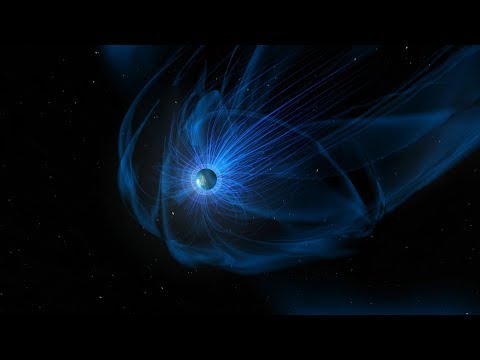
At its core, a magnetosphere forms around celestial bodies with internal dynamos generating magnetic fields, creating zones where these fields control plasma dynamics. The solar wind compresses the field on the dayside, forming a bow shock and turbulent magnetosheath, while the nightside stretches into a vast magnetotail prone to substorms. Key processes include Kelvin-Helmholtz instabilities at the magnetopause, driving plasma transport, and MHD waves propagating energy through the system. Pressure balance defines the magnetopause, fluctuating with solar wind intensity, while phenomena like plasmoids eject energy down the tail.
🌍 Cultural Impact
Earth's magnetosphere captivates public imagination through auroras—vibrant displays born from solar particles funneled along field lines—and space weather threats to satellites and power grids. In popular culture, it features in sci-fi like solar flares disrupting communications, echoing real risks from coronal mass ejections. Broader impacts include protecting atmospheres, as seen in Mars' lost magnetosphere contributing to its barren state, influencing planetary science narratives. Missions like NASA's Magnetospheric Multiscale probe demystify these processes, bridging hard science with global fascination for cosmic shields.
🔮 Legacy & Future
Advancing missions like Parker Solar Probe and future Europa Clipper promise deeper insights into magnetospheric diversity, from gas giants' colossal fields to exoplanet implications. Challenges persist in modeling multiscale interactions, from kilometer-scale reconnections to global dynamics, vital for space weather forecasting. As humanity eyes Mars colonization, understanding magnetospheric erosion informs habitability. The field evolves with Artificial Intelligence (/technology/artificial-intelligence) simulations, potentially revolutionizing predictions of geomagnetic storms and interstellar medium effects.
Key Facts
- Year
- 1950s-present
- Origin
- Earth's space environment, solar system
- Category
- science
- Type
- science
Frequently Asked Questions
What generates a planet's magnetosphere?
An internal dynamo in the molten core, like Earth's iron-nickel outer core convection, produces the magnetic field that defines the magnetosphere boundaries and dynamics[1][6]. Without it, solar wind strips atmospheres, as with Mars.
How does solar wind interact with the magnetosphere?
Solar wind creates a bow shock, compressing the field into a magnetosheath of turbulent plasma, with the magnetopause balancing pressures; nightside forms a magnetotail storing energy for substorms[1][2][3].
What causes auroras?
Charged particles from solar wind enter via magnetic reconnection, spiral along field lines into polar atmospheres, exciting gases to glow—oxygen green, nitrogen purple[1][4].
Why study other planets' magnetospheres?
Comparative analysis reveals dynamo requirements for habitability; Jupiter's massive field traps radiation, Venus lacks one leading to erosion, informing exoplanet assessments[1][2].
What is magnetic reconnection?
Field lines break and reform, releasing energy and allowing plasma mixing; key for substorms, particle acceleration, and auroral powering across scales from km to global[1][4].
References
- en.wikipedia.org — /wiki/Magnetosphere
- lasp.colorado.edu — /mop/files/2018/08/Heliophysics_-Plasma-Physics-Chapter-10.pdf
- britannica.com — /science/magnetosphere
- pmc.ncbi.nlm.nih.gov — /articles/PMC6428226/
- ntrs.nasa.gov — /citations/19810016113
- courses.mooc.fi — /org/uh-physics/courses/sustainable-space/chapter-6/magnetosphere
- agupubs.onlinelibrary.wiley.com — /doi/abs/10.1029/95RG03508
- fiveable.me — /space-physics/unit-6