
Contents
Overview
The roots of live sound mixing stretch back to the early days of public address systems in the late 19th and early 20th centuries, where rudimentary amplification was used for speeches and performances. Early pioneers like Al Jolson's 1927 film 'The Jazz Singer' showcased the nascent potential of synchronized sound, though true live mixing as we know it began to coalesce with the advent of multi-microphone setups and rudimentary mixing boards in the mid-20th century. The post-World War II era saw the rise of touring bands and larger venues, necessitating more sophisticated control over sound. Companies like Acoustic Research and later Altec Lansing began developing specialized equipment. By the 1960s and 70s, with the explosion of rock and roll and the demand for stadium-level sound, dedicated live sound engineers and purpose-built mixing consoles from manufacturers like Midas and Soundcraft became indispensable, transforming the live music experience.
⚙️ How It Works
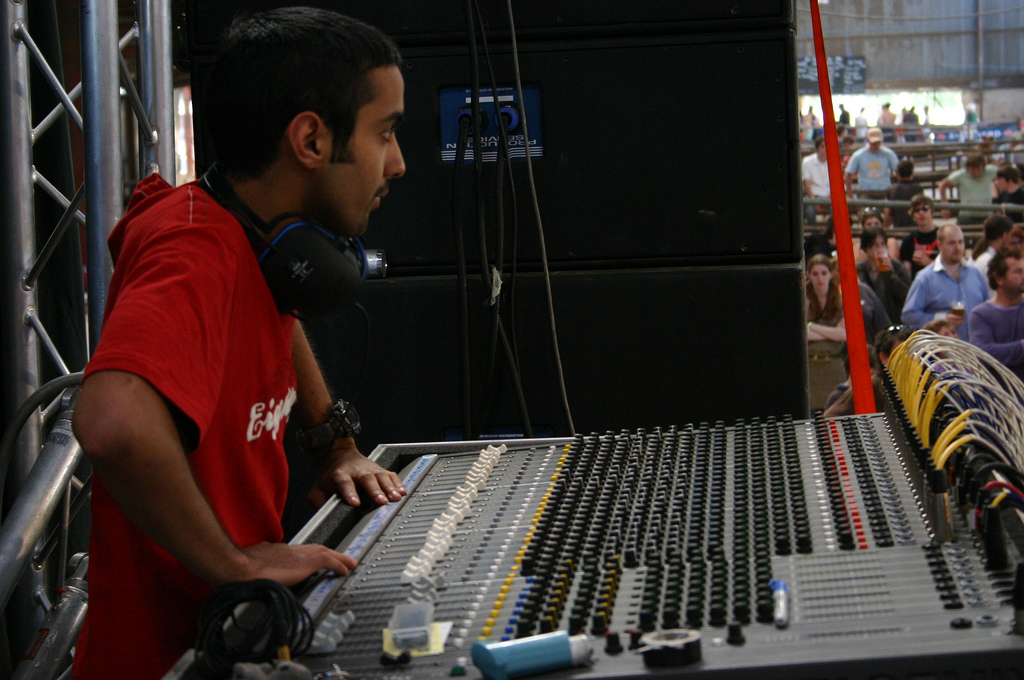
At its core, live sound mixing involves capturing audio signals from various sources—microphones on instruments like drum kits and vocals, direct inputs from electric guitars and basses, and playback devices—and routing them through a mixing console or digital audio workstation (DAW). The engineer then manipulates these signals using faders for volume, EQs (equalizers) to shape tonal balance (e.g., boosting low frequencies for warmth or cutting high frequencies for clarity), compressors to control dynamic range, and effects processors for reverb, delay, and modulation. Each processed signal is then sent to an amplification system and finally to loudspeakers positioned throughout the venue to deliver a consistent and pleasing sound to the audience. The engineer constantly monitors the mix, making real-time adjustments based on the performance, room acoustics, and audience feedback.
📊 Key Facts & Numbers
The global market for audio mixing consoles alone was estimated to be worth over $1.5 billion in 2023, with digital consoles accounting for a significant and growing portion. A typical large-scale concert might utilize a mixing console with over 64 input channels, allowing for the precise control of every microphone and direct input. The average loudspeaker system for a major tour can comprise hundreds of individual speaker cabinets, weighing tens of thousands of pounds and requiring immense power. A single live sound engineer might work over 100 shows a year, often traveling thousands of miles. The latency in digital audio processing, a critical factor in live sound, is typically measured in milliseconds. Top-tier systems reportedly achieve less than 5ms round-trip delay.
👥 Key People & Organizations
Key figures in live sound mixing include engineers like Bob Ludwig, renowned for his mastering work but also influential in live sound aesthetics, and Jim Lovell, a legendary FOH engineer for bands like The Rolling Stones. Organizations such as the Audio Engineering Society (AES) play a crucial role in setting standards and fostering knowledge exchange. Manufacturers like Yamaha, Harman International (which owns Soundcraft and JBL), Klark Teknik, and Avid are titans in the console and processing hardware space, continually pushing technological boundaries. Software developers like Waves and FabFilter provide essential plugins and virtual processing tools that are now ubiquitous in live rigs.
🌍 Cultural Impact & Influence
Live sound mixing has profoundly shaped the modern music industry and live performance culture. It dictates how audiences perceive everything from intimate acoustic sets to massive stadium rock shows. The ability to achieve pristine, powerful sound has enabled genres like rock music, pop music, and hip-hop to reach global audiences with a consistent sonic identity. The development of sophisticated monitoring systems, allowing musicians to hear themselves clearly on stage, has directly influenced performance techniques and musical complexity. Furthermore, the aesthetic of a live show, including the visual presence of large speaker arrays and the engineer's console, has become an integral part of the overall concert experience, impacting everything from stage design to fan expectations.
⚡ Current State & Latest Developments
The current landscape of live sound mixing is dominated by the transition to increasingly powerful and user-friendly digital consoles and sophisticated networking protocols like AES67 and Dante. Cloud-based mixing and remote control capabilities are becoming more prevalent, allowing engineers to manage shows from anywhere. The integration of AI and machine learning for tasks like automatic gain staging and acoustic correction is an emerging trend, promising to streamline workflows. Immersive audio formats, such as Dolby Atmos for live events, are also gaining traction, offering new possibilities for spatial sound design. Manufacturers like Yamaha with their RIVAGE series and Avid with their VENUE systems are at the forefront of these advancements, offering integrated solutions for complex productions.
🤔 Controversies & Debates
One of the most persistent controversies in live sound mixing revolves around the perceived loudness war, where some engineers prioritize sheer volume over sonic fidelity, leading to listener fatigue and a compressed dynamic range. Another debate centers on the use of in-ear monitors versus traditional wedge monitors, with proponents of each system arguing for superior performance and comfort. The increasing reliance on digital processing and automation also sparks discussions about the 'soul' of live sound and whether technology is diminishing the human element of an engineer's craft. Furthermore, the acoustic challenges of diverse venues, from reverberant churches to open-air festivals, remain a constant source of debate regarding the best approaches to sound reinforcement.
🔮 Future Outlook & Predictions
The future of live sound mixing points towards greater integration of artificial intelligence for automated adjustments and predictive acoustic modeling. Expect to see more networked audio systems, enabling seamless integration across complex productions and facilitating remote collaboration. The rise of augmented reality (AR) could allow engineers to visualize sound sources and acoustic properties in real-time within the venue. Furthermore, the demand for personalized audio experiences might lead to more sophisticated audience-specific sound delivery systems. The development of more efficient and powerful amplification and speaker technologies will continue to push the boundaries of what's sonically possible in live environments, potentially leading to entirely new forms of live performance.
💡 Practical Applications
Live sound mixing is indispensable across a vast array of applications. In rock concerts, it ensures powerful, clear vocals and instruments cut through dense arrangements. For theatrical productions, it balances dialogue, sound effects, and musical cues to create immersive storytelling. Conferences and trade shows rely on it for clear speech reinforcement and presentation audio. Sporting events use it for anthems, announcements, and crowd engagement. Religious services often employ it to amplify sermons and music. Even smaller venues like music clubs and bars utilize it to enhance the performance of local bands and DJs, demonstrating its ubiquitous presence in public life.
Key Facts
- Category
- technology
- Type
- topic