
Contents
- 🎵 Origins & History
- ⚙️ Defining Characteristics
- 📊 Key Facts & Numbers
- 👥 Notable Island Nations & Leaders
- 🌍 Cultural Impact & Influence
- ⚡ Current State & Latest Developments
- 🤔 Controversies & Debates
- 🔮 Future Outlook & Predictions
- 💡 Economic Models & Vulnerabilities
- 📚 Related Topics & Deeper Reading
- Frequently Asked Questions
- References
- Related Topics
Overview
The concept of an island nation is as old as human migration itself, with early seafaring peoples establishing settlements on islands across the globe. Prehistoric migrations, such as the Lapita people's expansion across the Pacific Ocean starting around 1600 BCE, laid the groundwork for future island societies. Historically, island nations often developed distinct cultures due to their geographical isolation, fostering unique languages, traditions, and political structures. The rise of naval powers like Ancient Greece, Rome, and later European colonial empires, significantly impacted the sovereignty and development of many island states, leading to periods of both independence and subjugation. The post-World War II decolonization movement saw a surge in the number of newly independent island nations, particularly in the Caribbean and the Pacific.
⚙️ Defining Characteristics
Island nations are defined by their geographical relationship to the sea. This can range from a single, large landmass like Sri Lanka to vast archipelagos comprising thousands of islands, such as the Philippines or Japan. The degree of isolation varies immensely; some island nations are close to continental landmasses, facilitating trade and cultural exchange, while others are among the most remote places on Earth, like Pitcairn Island. This geographical reality shapes everything from their defense strategies, often reliant on naval capabilities, to their biodiversity and susceptibility to external influences. The very definition of an island nation can be complex, sometimes including states that share a continental shelf or are composed of fragmented territories.
📊 Key Facts & Numbers
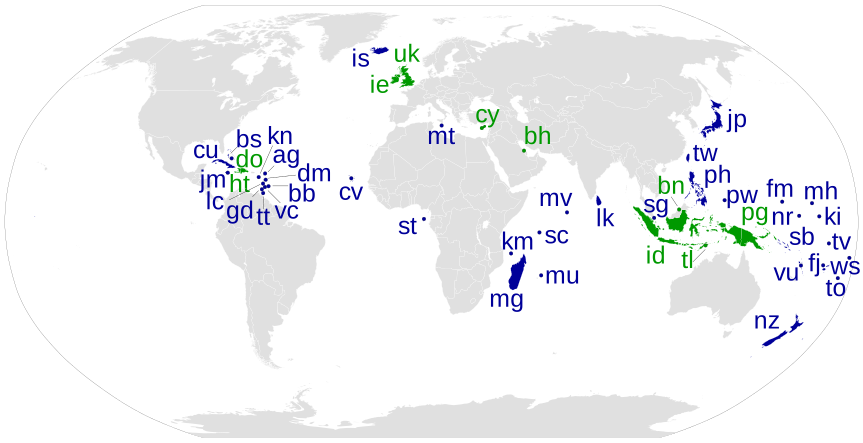
Globally, there are approximately 195 countries, and around 45-50 of these are considered island nations, representing roughly 25% of the world's sovereign states. Indonesia stands as the largest island country by both land area and population, with over 17,000 islands and a population exceeding 270 million. Conversely, Nauru is one of the smallest, with a land area of just 21 square kilometers. The Maldives boasts the lowest average elevation of any country, at just 1.5 meters above sea level, making it acutely vulnerable to rising sea levels. Many island nations, particularly in the Pacific, have Exclusive Economic Zones (EEZs) that are vastly larger than their terrestrial landmass, granting them significant control over marine resources.
👥 Notable Island Nations & Leaders
Notable island nations span the globe, each with unique characteristics. Japan, an archipelago nation in East Asia, is a global economic powerhouse with a rich cultural heritage. The United Kingdom, an island nation off the coast of mainland Europe, has a long history of global influence through its former empire. In the Caribbean, Cuba is the largest island nation, while Barbados is known for its tourism-driven economy. Leaders like Jacinda Ardern of New Zealand have gained international recognition for their leadership on issues ranging from climate change to social policy. The Seychelles in the Indian Ocean is celebrated for its pristine natural beauty and conservation efforts.
🌍 Cultural Impact & Influence
Island nations have profoundly influenced global culture, art, and literature. The isolation of island life has often fostered unique artistic expressions, from the Māori art of New Zealand to the Reggae music of Jamaica. The romanticized image of the 'island paradise' has been a recurring theme in Western literature and film, often shaping tourism narratives and perceptions of these nations. Furthermore, the geopolitical positioning of island nations has played crucial roles in historical conflicts, such as the Battle of Midway during World War II, highlighting their strategic importance. The resilience and adaptability of island communities in the face of environmental and economic challenges also serve as powerful narratives of human perseverance.
⚡ Current State & Latest Developments
In the current geopolitical climate, island nations are increasingly vocal on the international stage, particularly concerning climate change and maritime security. Many are at the forefront of advocating for stronger global climate action, as they face immediate threats from rising sea levels and extreme weather events. The Alliance of Small Island States (AOSIS) serves as a crucial bloc in international climate negotiations, pushing for ambitious emissions reductions and climate finance. Economically, many island nations are striving to diversify their economies beyond traditional sectors like tourism and fishing, exploring opportunities in renewable energy, digital services, and sustainable blue economies. The ongoing territorial disputes in regions like the South China Sea also directly impact several island nations, affecting their sovereignty and resource access.
🤔 Controversies & Debates
A significant controversy surrounding island nations revolves around their vulnerability to climate change and the perceived inadequacy of international support. Many low-lying island states, such as Tuvalu and the Marshall Islands, face the existential threat of submersion, leading to debates about climate justice, climate refugees, and the responsibility of industrialized nations. Another point of contention is the management of vast Exclusive Economic Zones (EEZs), which can lead to disputes over fishing rights and resource exploitation, particularly with larger, more powerful nations. The economic models of some island nations, heavily reliant on tourism, have also faced criticism for potential environmental impacts and economic instability, as demonstrated during the COVID-19 pandemic when travel restrictions devastated their economies.
🔮 Future Outlook & Predictions
The future for island nations is inextricably linked to the trajectory of global climate change. Projections indicate that many low-lying island states could become uninhabitable within this century, necessitating large-scale adaptation strategies, potential relocation, and international legal frameworks for climate displacement. There is a growing focus on building resilience through sustainable development, investing in renewable energy sources like solar and wind power, and implementing robust coastal protection measures. Furthermore, the concept of the 'blue economy' – sustainable use of ocean resources for economic growth – holds significant promise for many island nations, provided it is managed responsibly. The geopolitical influence of island nations may also grow as they champion critical global issues like climate action and ocean conservation.
💡 Economic Models & Vulnerabilities
Island nations exhibit a remarkable diversity of economic models, often shaped by their unique resources and geographical advantages. Many rely heavily on tourism, leveraging their natural beauty and cultural attractions to drive revenue, as seen in the Bahamas and Fiji. Others depend on natural resources, with Papua New Guinea and Solomon Islands having significant mining and forestry sectors, while Iceland has capitalized on geothermal energy and fisheries. Some have become vital transit hubs, like Singapore, a city-state island nation that is a major global port and financial center. However, this reliance on specific sectors, coupled with their remoteness and vulnerability to external shocks like climate change and global economic downturns, presents significant economic challenges. The concept of sustainable development is paramount for their long-term viability.
Key Facts
- Year
- Ongoing
- Origin
- Global
- Category
- places
- Type
- place
Frequently Asked Questions
What percentage of countries are island nations?
Approximately 25% of the world's sovereign states are island nations, meaning their primary territory consists of one or more islands. This translates to roughly 45-50 countries out of the nearly 195 recognized nations globally. This significant proportion highlights the widespread presence of island states across oceans like the Pacific, Atlantic, Indian, and Arctic.
What are the biggest challenges facing island nations?
The most pressing challenge is climate change, particularly sea-level rise, which threatens low-lying island nations with submersion. Other significant challenges include economic vulnerability due to reliance on tourism or limited resources, susceptibility to natural disasters like hurricanes and tsunamis, limited access to global markets, and in some cases, issues related to resource management and territorial disputes. The COVID-19 pandemic also starkly revealed their vulnerability to global economic shocks.
How do island nations differ economically?
Island nations exhibit a wide range of economic models. Many, like the Maldives and Barbados, thrive on tourism, capitalizing on their natural beauty. Others, such as Papua New Guinea, rely on extractive industries like mining and logging. Some, like Singapore, function as major global transit hubs and financial centers. A growing focus is on developing the 'blue economy,' which involves the sustainable use of ocean resources for economic growth, encompassing fisheries, marine biotechnology, and renewable energy.
What is the significance of Exclusive Economic Zones (EEZs) for island nations?
Exclusive Economic Zones (EEZs) are crucial for island nations as they grant sovereign rights over marine resources within a 200-nautical-mile radius from their coastlines. For many island states, their EEZs are vastly larger than their landmass, providing access to significant fisheries, potential mineral resources, and control over shipping lanes. Managing these vast marine territories effectively is vital for their economic development and national security, though it can also lead to disputes with larger nations.
Are island nations more prone to conflict?
Historically, island nations have sometimes been more stable than continental states due to their natural defenses provided by the sea, which historically made them harder to conquer. However, they are not immune to conflict. Geopolitical tensions, particularly over strategic locations or resource-rich EEZs (e.g., in the South China Sea), can lead to disputes. Internal conflicts can also arise, often linked to economic disparities or political instability. Their vulnerability can also make them targets for external influence or intervention.
How are island nations adapting to climate change?
Adaptation strategies vary widely. Many are investing in coastal defenses like seawalls and mangrove restoration. Others are exploring innovative solutions such as elevating infrastructure, developing salt-tolerant agriculture, and improving early warning systems for extreme weather. Some nations are also considering managed relocation of communities as a last resort. A significant part of their adaptation strategy involves advocating for global emissions reductions and seeking international climate finance to support these efforts.
What does the future hold for island nations regarding climate change?
The future is precarious for many low-lying island nations. Projections suggest that some could become uninhabitable within this century, leading to potential mass displacement. However, there is also a strong push towards building resilience through sustainable development, renewable energy, and the blue economy. International cooperation and ambitious global climate action are critical determinants of their long-term survival and prosperity. The concept of 'climate justice' will likely remain a central theme in their international relations.