
Contents
Overview
The intellectual roots of diffusion of innovations stretch back further than Everett Rogers' seminal 1962 book, with early observations appearing in the work of sociologist Gabriel Tarde in France around the turn of the 20th century, who studied the imitation of innovations. Later, agricultural economists like Bryce Ryan and Neal Gross conducted groundbreaking studies in the 1940s on how farmers in Iowa adopted new hybrid seed varieties, providing empirical data on adoption rates and influencing factors. Rogers synthesized these disparate threads, formalizing the theory and its core components in his widely cited work, which itself has undergone multiple revisions, with the fifth edition published in 2003. This rich lineage underscores that understanding how new ideas spread is not a modern problem but a persistent human and social phenomenon.
⚙️ How It Works
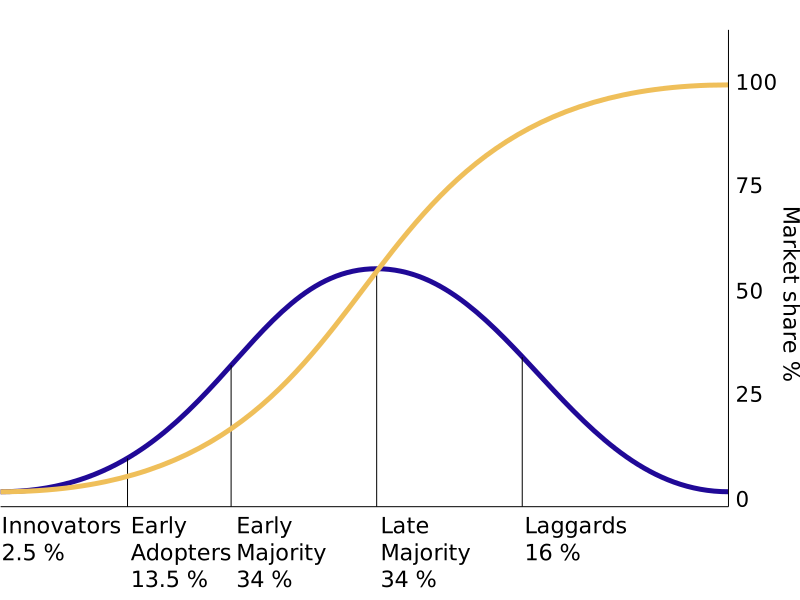
At its core, diffusion of innovations operates through five key elements: the innovation itself (its perceived attributes like relative advantage, compatibility, complexity, trialability, and observability), adopter categories (individuals or units within a social system who adopt at different rates), communication channels (the means by which messages about an innovation are exchanged), time (the duration of the innovation-decision process, the rate of adoption, and the adopter categories), and the social system (a set of interrelated units engaged in joint problem-solving to accomplish a common goal). Rogers famously categorized adopters into five groups: innovators (risk-takers, 2.5%), early adopters (opinion leaders, 13.5%), early majority (deliberate, 34%), late majority (skeptical, 34%), and laggards (traditional, 16%). The speed at which an innovation moves through these groups, often visualized as an S-shaped curve, is critical for its ultimate success.
📊 Key Facts & Numbers
The diffusion process is quantifiable, with specific adoption rates often measured. For instance, smartphones saw an adoption rate that reached over 80% of the U.S. population by 2019, a stark contrast to the slower diffusion of technologies like the automobile which took decades to achieve similar penetration. Rogers' original research indicated that approximately 2.5% of a population are typically innovators, the first to adopt new ideas, followed by 13.5% early adopters. Reaching critical mass, the point where adoption becomes self-sustaining, often occurs when 15-20% of the population has adopted an innovation. The average adoption period for a new idea can range from a few years for simple technologies to over a decade for complex societal changes, with market penetration often exceeding 50% within 5-10 years for successful innovations.
👥 Key People & Organizations
The central figure in popularizing the theory is Everett Rogers, a communication theorist whose 1962 book, Diffusion of Innovations, became the foundational text. His work built upon earlier research by scholars like Gabriel Tarde and Bryce Ryan and Neal Gross. Key organizations that have utilized and advanced the theory include Regis McKenna, a marketing consultancy that applied diffusion principles to technology marketing, and various public health organizations like the World Health Organization (WHO), which uses diffusion models to spread health interventions globally. Academic institutions worldwide continue to research and refine diffusion models, with numerous university departments focusing on communication, sociology, and marketing.
🌍 Cultural Impact & Influence
The diffusion of innovations theory has profoundly shaped how we understand and implement change across numerous domains. In marketing, it provides a framework for understanding consumer adoption cycles, guiding product launches and advertising strategies for everything from Apple iPhones to Netflix streaming services. In public health, it's instrumental in disseminating life-saving practices, such as handwashing campaigns during pandemics or the adoption of contraceptive methods. The theory also influences organizational change management, helping leaders navigate the introduction of new technologies or processes within companies like IBM or Microsoft. Its principles are visible in the spread of social media platforms and the adoption of renewable energy technologies, demonstrating its pervasive influence on societal evolution.
⚡ Current State & Latest Developments
In the current era, the diffusion of innovations theory is being tested and adapted by the unprecedented speed of digital technologies and global connectivity. The rapid ascent of TikTok and the instantaneous global reach of cryptocurrencies present new challenges to traditional diffusion models, particularly regarding the acceleration of the adoption curve and the blurring lines between adopter categories. Researchers are increasingly exploring how network effects and influencer marketing on platforms like Instagram and YouTube impact diffusion rates. Furthermore, the theory is being applied to understand the spread of misinformation and disinformation, highlighting its dual capacity to explain both beneficial and detrimental innovations. The ongoing development of AI tools and their integration into everyday life is another major area where diffusion dynamics are under intense scrutiny.
🤔 Controversies & Debates
Despite its widespread acceptance, the diffusion of innovations theory is not without its critics and controversies. One persistent debate centers on the overemphasis on individual adopter characteristics, with some arguing that structural factors like economic inequality, political power, and institutional barriers play a more significant role in adoption than Rogers' model fully accounts for. The theory has also been criticized for its Western-centric bias, potentially overlooking different cultural contexts and decision-making processes in non-Western societies. Furthermore, the distinction between categories, particularly the sharp lines drawn between the early and late majority, can be artificial, as adoption is often a more fluid and iterative process. The application of diffusion models to controversial innovations, such as tobacco products or certain political ideologies, also raises ethical questions about whether the theory implicitly endorses the spread of all innovations.
🔮 Future Outlook & Predictions
The future outlook for diffusion of innovations suggests a continued evolution, particularly in understanding diffusion within complex, interconnected digital ecosystems. We can anticipate more sophisticated modeling that incorporates big data analytics to track diffusion in real-time and predict adoption trajectories with greater accuracy. The theory will likely be increasingly applied to understanding the diffusion of sustainability practices and circular economy principles as global environmental concerns mount. Emerging technologies like the metaverse and Web3 will present new frontiers for diffusion research, potentially leading to entirely new adoption patterns. Experts predict that the ability to effectively manage and influence diffusion will become an even more critical skill for organizations and governments navigating rapid technological and social change.
💡 Practical Applications
The practical applications of diffusion of innovations are vast and varied. In marketing, it informs the development of go-to-market strategies for new consumer electronics, software, and services, helping companies identify target audiences and tailor messaging. I
Key Facts
- Category
- philosophy
- Type
- topic