
Contents
Overview
Deep learning has its roots in the 1940s, when Warren McCulloch and Walter Pitts proposed the first artificial neural network model. However, it wasn't until the 1980s that the field started to gain momentum, with the work of researchers like John Hopfield and David Rumelhart. Today, deep learning is a key area of research in machine learning, with applications in computer vision, speech recognition, and natural language processing. Companies like NVIDIA, Intel, and AMD are investing heavily in the development of specialized hardware for deep learning, such as graphics processing units (GPUs) and tensor processing units (TPUs). Researchers like Fei-Fei Li and Demis Hassabis are also exploring the potential of deep learning in areas like healthcare and education.
🤖 Deep Learning Architectures
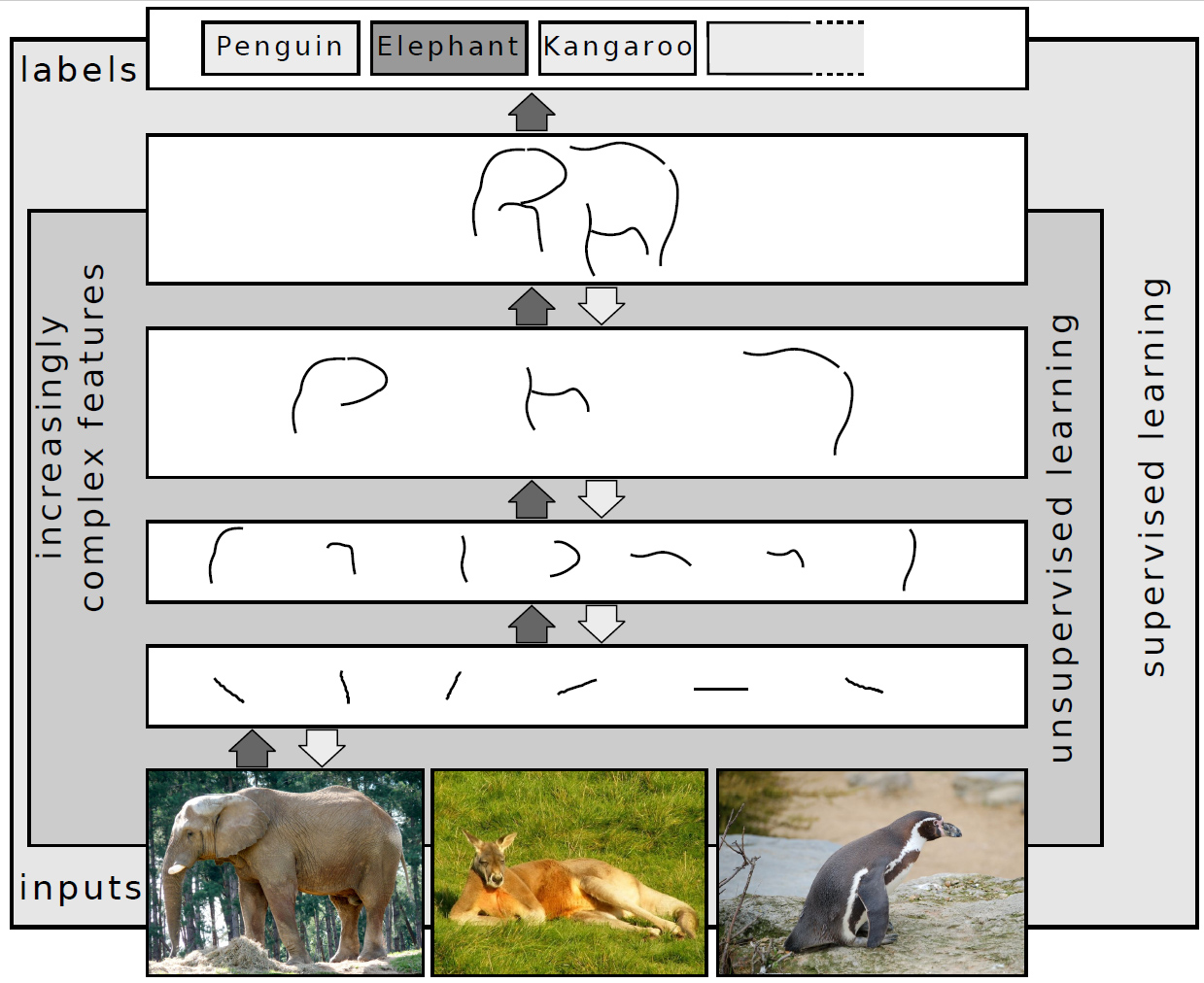
Some common deep learning network architectures include fully connected networks, deep belief networks, recurrent neural networks, convolutional neural networks, generative adversarial networks, transformers, and neural radiance fields. These architectures have been applied to fields including computer vision, speech recognition, natural language processing, machine translation, bioinformatics, drug design, medical image analysis, climate science, material inspection, and board game playing. For example, the convolutional neural network (CNN) architecture has been used in image recognition tasks, such as the ImageNet Large Scale Visual Recognition Challenge (ILSVRC), which was won by a team led by Alex Krizhevsky in 2012. The transformer architecture, on the other hand, has been used in natural language processing tasks, such as machine translation and text generation, with models like BERT and RoBERTa achieving state-of-the-art results.
🌐 Applications of Deep Learning
Deep learning has been applied to various fields, including computer vision, speech recognition, natural language processing, and bioinformatics. In computer vision, deep learning has been used for image recognition, object detection, and image segmentation tasks. For example, the self-driving car company Waymo, founded by Sebastian Thrun and Anthony Levandowski, uses deep learning to detect and recognize objects on the road. In speech recognition, deep learning has been used for speech-to-text tasks, with models like Google's Voice Search and Apple's Siri achieving high accuracy. Researchers like Yoshua Bengio and Ian Goodfellow have also explored the potential of deep learning in areas like robotics and autonomous systems.
📊 Future of Deep Learning
The future of deep learning is exciting and rapidly evolving. With the increasing availability of large datasets and computational resources, researchers are exploring new architectures and applications of deep learning. For example, the field of explainable AI (XAI) is focused on developing techniques to interpret and understand the decisions made by deep learning models. Researchers like Christopher Manning and Andrew Ng are also exploring the potential of deep learning in areas like healthcare and education. Companies like Facebook and Google are investing heavily in the development of deep learning-based systems for tasks like facial recognition and natural language processing. As the field continues to evolve, we can expect to see new and innovative applications of deep learning in various industries and domains.
Key Facts
- Year
- 2010s
- Origin
- United States
- Category
- technology
- Type
- concept
Frequently Asked Questions
What is deep learning?
Deep learning is a subset of machine learning that utilizes multilayered neural networks to perform complex tasks such as image recognition, speech recognition, and natural language processing.
What are some common deep learning architectures?
Some common deep learning architectures include fully connected networks, deep belief networks, recurrent neural networks, convolutional neural networks, generative adversarial networks, transformers, and neural radiance fields.
What are some applications of deep learning?
Deep learning has been applied to various fields including computer vision, speech recognition, natural language processing, machine translation, bioinformatics, drug design, medical image analysis, climate science, material inspection, and board game playing.
Who are some notable researchers in the field of deep learning?
Some notable researchers in the field of deep learning include Andrew Ng, Geoffrey Hinton, Yann LeCun, Fei-Fei Li, and Demis Hassabis.
What is the future of deep learning?
The future of deep learning is exciting and rapidly evolving, with new architectures and applications being explored, and companies like Facebook and Google investing heavily in its research and development.