
Contents
Overview
Command and Control (C2) traces its roots to ancient military practices where leaders like Sun Tzu emphasized information superiority and decisive direction, but formalized definitions emerged in the 20th century amid World War II's demand for coordinated operations across vast theaters. The U.S. Department of Defense codified C2 in Joint Publication 1-02 as 'the exercise of authority and direction by a properly designated commander over assigned and attached forces in the accomplishment of the mission,' drawing from NATO's 1988 articulation of authority over resources for common goals. Post-Cold War evolutions incorporated computers and intelligence, expanding to C3 (Command, Control, Communications) and C4ISR (adding Computers, Intelligence, Surveillance, Reconnaissance), reflecting technological leaps from analog signals to digital networks.
⚙️ How It Works
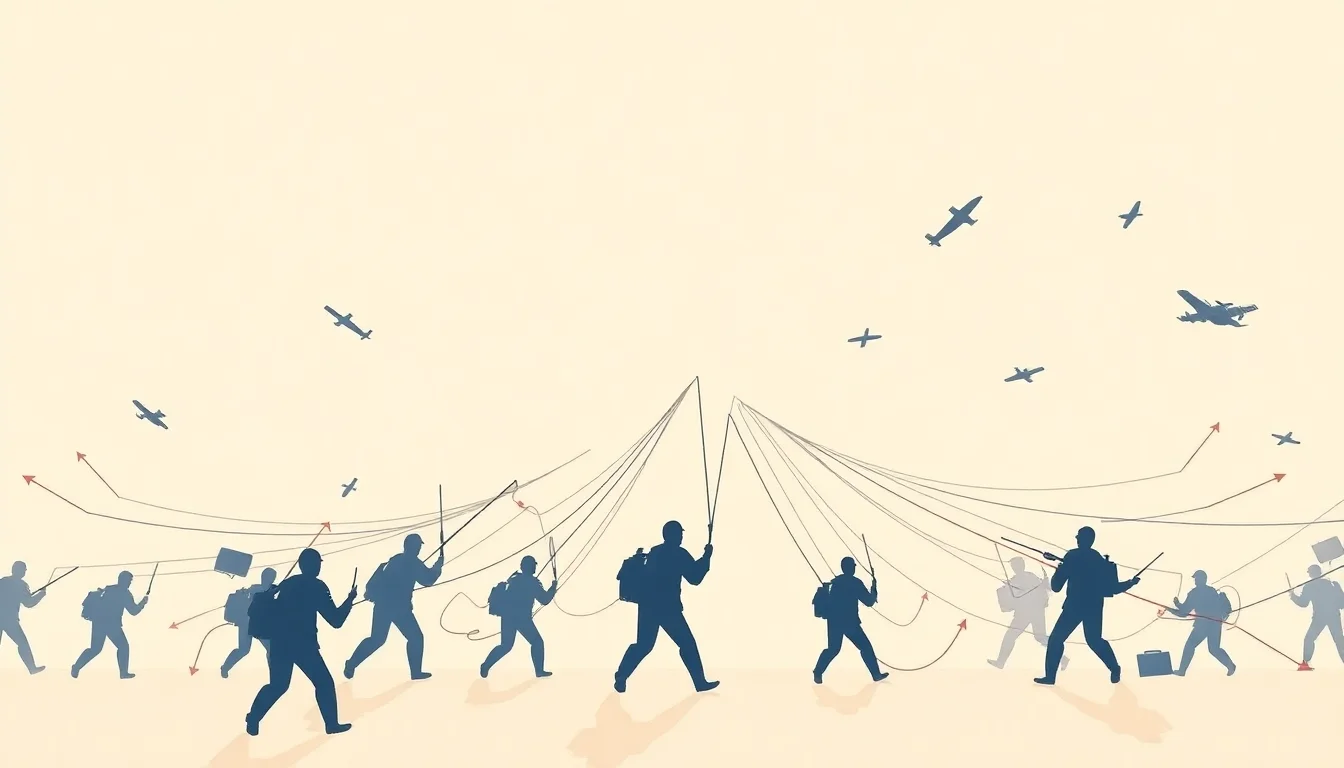
At its core, C2 functions through personnel, equipment, communications, facilities, and procedures that enable planning, directing, coordinating, and controlling operations, as defined by NIST and DoD standards. Command represents the authority to assign missions based on knowledge, while control verifies and corrects activities to meet objectives; communication ensures liaison between units, computers handle data processing, and intelligence provides collection and analysis. This manifests across war's levels: strategic (e.g., presidential directives), operational (e.g., Air Tasking Orders), and tactical (battle management), with humans at the center integrating these elements for adaptive decision-making.
🌍 Cultural Impact
Beyond battlefields, C2 influences organizational management, emergency response, and corporate hierarchies, symbolizing efficient leadership in high-stakes environments like disaster relief or cybersecurity operations. Popular culture immortalizes it in films like Dr. Strangelove satirizing nuclear C2 (NC2) and video games such as Command & Conquer, embedding the concept in public consciousness as the art of turning disparate forces into a unified machine. Its principles echo in modern platforms like Artificial Intelligence (/technology/artificial-intelligence) for automated decision aids and Automation (/technology/automation), blurring lines between military and civilian applications.
🔮 Legacy & Future
C2's future hinges on AI-driven networks, resilient cyber defenses, and multi-domain operations amid great power competition, promising hyper-connected systems that outpace adversaries. Challenges include information overload and electronic warfare disruptions, spurring innovations in Quantum Computing (/technology/quantum-computing) for secure comms and machine learning for predictive control. As doctrine evolves per U.S. Marine Corps MCDP 6, effective C2 will demand human-centric adaptability, ensuring it remains the linchpin of victory in contested environments.
Key Facts
- Year
- 20th-21st century
- Origin
- Military doctrines (U.S. DoD, NATO)
- Category
- technology
- Type
- concept
Frequently Asked Questions
What is the core definition of Command and Control?
C2 is the exercise of authority and direction by a designated commander over forces to accomplish missions, using personnel, equipment, communications, and procedures for planning and coordination, per DoD JP 1-02 and NIST standards.
How does C2 differ from command and control?
Command is the authority to assign missions; control is directing and verifying execution. Together, they form C2, with communication, computers, and intelligence (C3I) enabling the process across strategic, operational, and tactical levels.
What are the key components of a C2 system?
Core elements include command (authority), control (verification), communications (liaison), computers (data processing), and intelligence (info analysis), forming C3I and expanding to C4ISR in modern contexts.
How has C2 evolved with technology?
From analog WWII systems to digital C4ISR networks, incorporating AI, quantum-secure comms, and multi-domain ops, as seen in U.S. Marine Corps doctrine emphasizing human adaptability.
What is the role of C2 in non-military contexts?
C2 principles apply to crisis management, corporate leadership, and cybersecurity, providing frameworks for coordinated action under uncertainty, much like military applications.
References
- csrc.nist.gov — /glossary/term/command_and_control
- c4icommunication.com — /what-does-command-and-control-mean-in-military-system/
- youtube.com — /watch
- en.wikipedia.org — /wiki/Command_and_control
- airuniversity.af.edu — /Wild-Blue-Yonder/Articles/Article-Display/Article/3125018/command-and-control-t
- man.fas.org — /dod-101/navy/docs/fun/part20.htm
- dodccrp.org — /files/nec2_short_course/NEC2%20Short%20Course%20Module%201%20-%20Command%20and%
- marines.mil — /Portals/1/Publications/MCDP%206.pdf