
Contents
Overview
Business Continuity Management (BCM) is the proactive discipline of establishing robust systems and processes to ensure an organization can maintain essential functions during and after disruptive incidents. It’s not just about disaster recovery; BCM encompasses prevention, preparedness, response, and recovery, aiming to minimize operational downtime and financial losses. Globally, organizations invest billions annually in BCM strategies, driven by increasing threats from cyberattacks, natural disasters, and geopolitical instability. Key frameworks like ISO 22301 provide standardized guidance, while specialized software platforms help automate risk assessments and response plans. Effective BCM is a critical component of overall risk management, safeguarding reputation, regulatory compliance, and stakeholder trust in an unpredictable world.
🎵 Origins & History
The conceptual roots of Business Continuity Management (BCM) can be traced back to early industrial-era concerns about operational resilience, particularly in sectors like manufacturing and utilities where downtime had immediate, severe consequences. However, ISO 22301 is a standard for BCM.
⚙️ How It Works
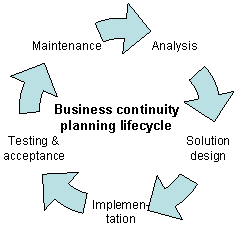
At its core, BCM operates through a cyclical process involving business impact analysis (BIA), risk assessment, strategy development, plan creation, testing, and maintenance. The BIA identifies critical business functions and the potential impact of their disruption, while risk assessment pinpoints threats and vulnerabilities. Based on these findings, strategies are devised—ranging from redundant systems and alternate work sites to manual workarounds. Detailed plans are then documented, outlining specific steps, roles, and communication protocols for responding to various scenarios. Crucially, these plans are regularly tested through exercises like tabletop simulations or full-scale drills, and then updated to reflect changes in the organization's structure, technology, or threat landscape. This iterative approach, often managed through BCM software platforms, ensures preparedness.
📊 Key Facts & Numbers
The global BCM market is substantial, projected to reach over $10 billion by 2027, growing at a compound annual growth rate (CAGR) of approximately 10%. Organizations typically spend between 1% and 5% of their IT budget on BCM initiatives. Studies by Gartner indicate that the average cost of downtime for a mid-sized business can exceed $100,000 per hour. Furthermore, regulatory mandates, such as GDPR in Europe and SOC 2 compliance in the US, increasingly require robust BCM frameworks, with over 70% of organizations reporting that regulatory compliance is a primary driver for their BCM investments. The financial services sector, in particular, dedicates significant resources, with some institutions allocating upwards of 15% of their operational budget to resilience.
👥 Key People & Organizations
Key figures in the evolution of BCM include individuals like Robert McCallum, a prominent voice in the early development of BCI, and organizations such as IBM, which developed foundational disaster recovery strategies in the mid-20th century. The International Organization for Standardization (ISO) has been instrumental through its development of the ISO 22301 standard for BCM. Major consulting firms like Deloitte, PwC, and KPMG offer extensive BCM services, advising global corporations. Technology providers, including BMC Software and Veritas Technologies, offer critical software solutions that underpin modern BCM practices, enabling automated risk assessments and response coordination.
🌍 Cultural Impact & Influence
BCM has profoundly shaped corporate culture, shifting the perception of resilience from an IT-specific concern to a strategic imperative for the entire enterprise. Its influence is evident in the widespread adoption of crisis communication protocols, the integration of BCM into CSR reporting, and the growing emphasis on supply chain resilience. The rise of cybersecurity threats has further amplified BCM's importance, making it a cornerstone of digital trust. Major incidents, such as the Equifax data breach in 2017 or the Colonial Pipeline cyberattack in 2021, serve as stark reminders of BCM's critical role in maintaining public confidence and operational continuity, influencing how businesses communicate their preparedness to stakeholders and consumers.
⚡ Current State & Latest Developments
In 2024-2025, BCM is increasingly integrating artificial intelligence (AI) and machine learning (ML) for predictive threat analysis and automated response orchestration. The focus is shifting from traditional disaster recovery to a broader concept of 'resilience engineering,' encompassing cyber, operational, and even geopolitical risks. The World Economic Forum consistently highlights supply chain disruption and cyber threats as top global risks, driving demand for more sophisticated BCM solutions. Companies are also prioritizing 'human continuity,' ensuring employee well-being and communication during crises, a trend accelerated by the COVID-19 pandemic. The adoption of cloud-based BCM platforms is also accelerating, offering greater scalability and accessibility for organizations of all sizes.
🤔 Controversies & Debates
A significant debate within BCM revolves around the balance between preparedness and agility. Critics argue that overly rigid, pre-defined plans can stifle innovation and hinder rapid adaptation to novel threats not covered in the BIA. Conversely, proponents of structured BCM emphasize that a well-tested framework provides the necessary foundation for effective response, preventing chaos during high-stress events. Another point of contention is the cost-benefit analysis; quantifying the ROI of BCM can be challenging, leading some organizations to underinvest. The increasing sophistication of cyberattacks, particularly ransomware, also raises questions about the efficacy of traditional BCM against rapidly evolving threats, prompting discussions on proactive threat hunting and adaptive security measures.
🔮 Future Outlook & Predictions
The future of BCM points towards hyper-personalization and predictive resilience. Expect AI-driven BCM systems that can anticipate disruptions based on real-time global data feeds, automatically reconfiguring resources and communication channels. The integration of BCM into the IoT ecosystem will enable monitoring of physical infrastructure for potential failures before they occur. Furthermore, as climate change intensifies, BCM will become more deeply intertwined with climate change adaptation strategies, requiring organizations to build resilience against increasingly frequent and severe weather events. The concept of 'autonomous BCM,' where systems can self-heal and self-recover with minimal human intervention, is also on the horizon, driven by advancements in robotics and automation.
💡 Practical Applications
BCM has direct applications across virtually every sector. In finance, it ensures the continuity of trading platforms and customer transactions, as mandated by regulators like the SEC. Healthcare organizations use BCM to maintain patient care during power outages or cyberattacks, safeguarding critical medical equipment and patient data. Retailers rely on BCM to keep supply chains moving and e-commerce platforms operational, especially during peak seasons or unexpected disruptions. Manufacturing firms implement BCM to prevent production line stoppages, while government agencies use it to ensure the delivery of essential public services during emergencies. Even small businesses leverage BCM principles to protect against data loss and maintain customer service.
Key Facts
- Category
- business
- Type
- topic