
Contents
Overview
The concept of black holes, initially termed 'completely collapsed gravitational objects,' has captivated scientists and science fiction enthusiasts for centuries. The theoretical groundwork was laid by John Michell in 1784, who suggested the existence of objects so massive that light could not escape their gravity. Albert Einstein's general theory of relativity in 1915 provided the mathematical framework, describing how mass warps spacetime and creates gravity. Karl Schwarzschild further developed this by proposing the existence of a singularity—a point of infinite density—within a very small volume. The understanding of stellar evolution, particularly the Chandrasekhar limit proposed by Subrahmanyan Chandrasekhar in 1931, established that stars exceeding a certain mass would collapse into either neutron stars or black holes. Sir Roger Penrose's work in 1965 solidified the theoretical possibility of black holes, and the term 'black hole' was popularized by John Wheeler in 1967. Early observational hints came from quasars, discovered in the 1950s and later understood to be powered by supermassive black holes at the centers of galaxies, a concept explored in relation to phenomena like the Perseus Black Hole.
🕳️ How It Works
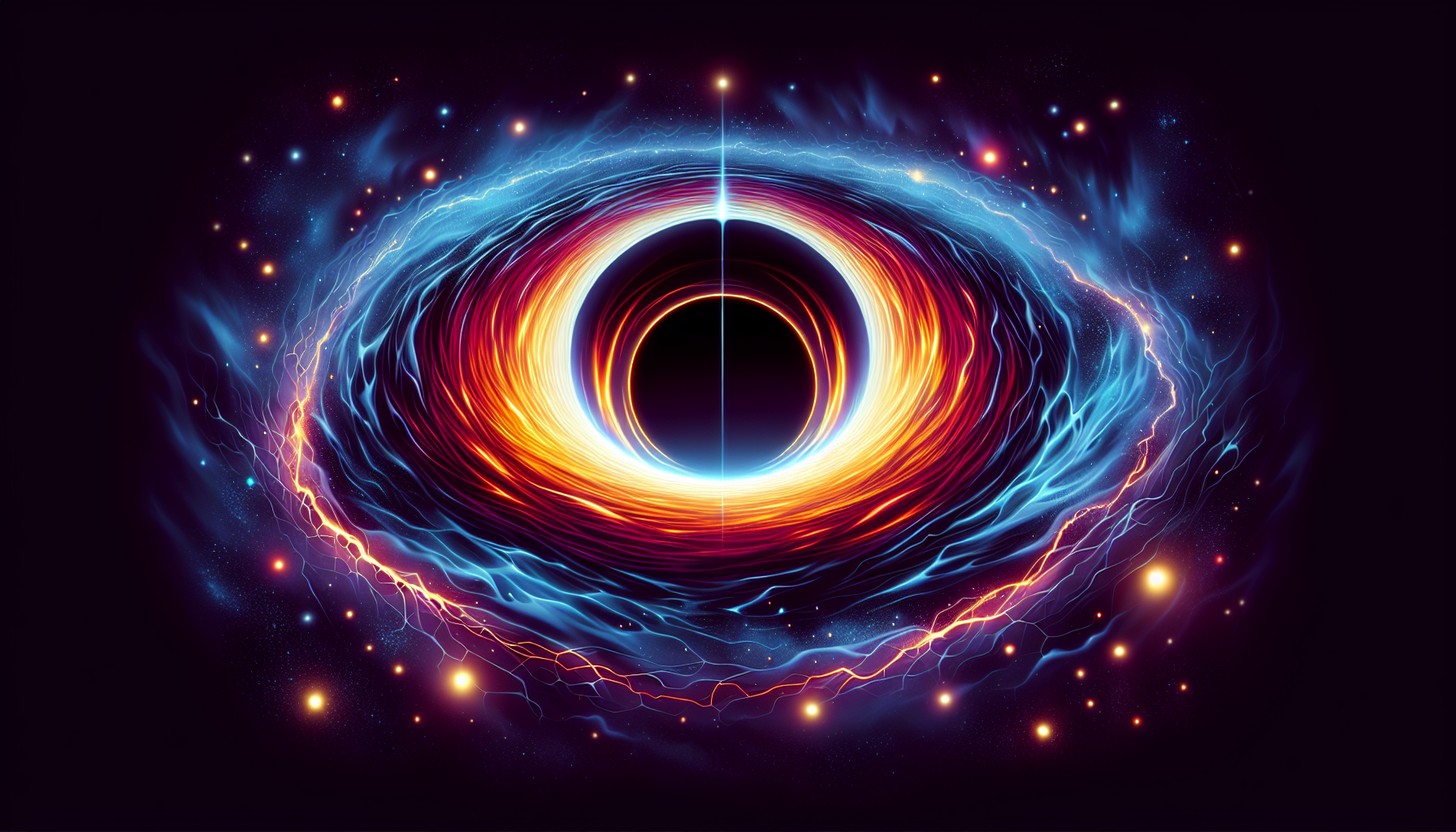
A black hole is fundamentally a region of spacetime where gravity is so intense that nothing, not even light, can escape. This extreme gravity arises from a massive amount of matter being compressed into an incredibly small space, creating a singularity at its core. Surrounding this singularity is the event horizon, a boundary that marks the point of no return; crossing it means inevitable capture by the black hole's gravity. Black holes do not emit or reflect light, making them invisible. However, their presence is inferred through their gravitational effects on nearby objects, such as stars orbiting them erratically or accretion disks of superheated gas and dust that emit X-rays. These effects are crucial for detection, as demonstrated by the study of Sagittarius A*, the supermassive black hole at the center of the Milky Way, and the first direct image of a black hole captured by the Event Horizon Telescope.
🌠 Cultural Impact
Black holes have permeated popular culture, inspiring awe, fear, and scientific curiosity. They are often depicted as cosmic vacuum cleaners or portals to other dimensions, though these portrayals are largely fictionalized. The concept of 'spaghettification'—the stretching and compression of matter falling into a black hole—is a scientifically accurate, albeit dramatic, consequence of their intense gravity. While not wormholes or shortcuts through spacetime as often imagined in science fiction, their extreme nature continues to fuel speculation about the universe's fundamental laws, touching upon ideas related to Simulation Theory and the very fabric of reality. The visual representation of black holes, such as the first image of M87*, has become iconic, sparking widespread interest akin to the public fascination with figures like MrBeast or platforms like Reddit.
⏳ Legacy & Future
The study of black holes continues to push the boundaries of astrophysics and our understanding of the universe. The detection of gravitational waves by LIGO in 2015 provided direct evidence of black hole mergers, opening a new window into observing these phenomena. Ongoing research aims to understand the formation of supermassive black holes, their role in galaxy evolution, and the nature of spacetime within and around them. While black holes are theoretically predicted to evaporate over extremely long timescales through Hawking radiation, their immense gravitational influence and the mysteries they hold ensure their continued relevance in scientific inquiry and public imagination. The exploration of black holes is a testament to human curiosity, much like the endeavors of scientists like Albert Einstein and the continuous advancements seen on platforms like Google.com.
Key Facts
- Year
- 1784-Present
- Origin
- Theoretical physics and astrophysics
- Category
- science
- Type
- concept
Frequently Asked Questions
What is a black hole?
A black hole is a region of spacetime where gravity is so strong that nothing, not even light, can escape. It is formed when a massive amount of matter is compressed into a very small space, creating an object of extreme density.
How are black holes formed?
Black holes are typically formed from the death of massive stars. When a star exhausts its nuclear fuel, its core collapses under its own gravity, leading to an explosion (supernova) and leaving behind a dense remnant that can become a black hole. Other mechanisms, like the direct collapse of gas, are theorized for supermassive black holes.
Can we see black holes?
Black holes themselves are invisible because they absorb all light. However, astronomers can detect their presence by observing their gravitational effects on surrounding matter, such as stars orbiting them or the emission of X-rays from superheated gas in accretion disks.
What is the event horizon?
The event horizon is the boundary around a black hole beyond which nothing, not even light, can escape. It is often referred to as the 'point of no return'.
Are black holes wormholes?
No, black holes are not wormholes. While wormholes are theoretical tunnels connecting different points in spacetime, black holes are regions of extreme gravity from which escape is impossible once the event horizon is crossed.
References
- science.nasa.gov — /universe/black-holes/
- en.wikipedia.org — /wiki/Black_hole
- nationalgeographic.com — /science/article/black-holes
- space.com — /15421-black-holes-facts-formation-discovery-sdcmp.html
- rmg.co.uk — /stories/space-astronomy/what-is-a-black-hole
- youtube.com — /watch
- reddit.com — /r/cosmology/comments/16444lc/what_are_black_holes_exactly/
- skyatnightmagazine.com — /space-science/how-black-holes-formed